 |
| All 50
states are categorized by patterns of gender disparities in this map by the Prison Policy Initiative. Click through for the full-sized map, or read the linked article. |

Showing posts with label corrections. Show all posts
Showing posts with label corrections. Show all posts
Tuesday, February 27, 2018
Even as prison populations decline, women in prison fare worse than men


Monday, April 24, 2017
Corrections aiming to be gold standard in treatment of mentally ill
 The Department of Corrections (DOC) is the largest provider of mental health services in the state of Alaska. With 33,000 bookings a year, 65% of those booked qualify as beneficiaries of the Alaska Mental Health Trust Authority, including 23% with a serious mental illness, according to Adam Rutherford, Chief Mental Health Officer for DOC.
In many areas, Alaska lags behind other states, but not in its treatment of the mentally ill in its correctional institutions, Rutherford said.“We are practicing evidenced-based interventions, we are a leader in this area,” he said, adding, “We want to be the gold standard in mental health care.”
 |
| L-R: DJJ Clinical Director Shannon Cross-Azbill, DJJ Chief Probation Officer Heidi Redick, DOC Director of Health and Rehabilitation Services Laura Brooks and DOC Chief Mental Health Officer Adam Rutherford. |
While it is often difficult to diagnose juveniles, DJJ Clinical Director Cross-Azbill said that the majority of those in DJJ have a mental health diagnosis including substance abuse, ADHD, depression and trauma-related disorders. They’ve recently been keeping track of Fetal Alcohol Syndrome Disorders and found 47% of the juveniles may be experiencing this, she added.
The panelists attributed the high numbers of those with a mental illness in both juvenile and adult systems to be partly in response to a lack of resources outside their systems.
Laura Brooks, who oversees all of DOC’s Health and Rehabilitative Services (HARS), explained the growth in prison treatment of the mentally ill as symptomatic of a shift in the 1960s away from funding state psychiatric hospitals and moving toward community mental health centers that were inadequately funded. Eventually, many of those with mental health issues ended up in correctional institutions, she said.
Not only is DOC Alaska’s largest behavioral treatment center it is also the state’s largest health care provider. It is also the largest medical facility, largest detox center, and substance abuse treatment center. The behavioral health staff has 21,000 contacts with offenders a year, according to Rutherford. The HARS staff of 200 sees 5,000 patients a day inpatient and 4,000 a day outpatient, according to Brooks.
DOC has followed the national movement to screen people coming into the system to assess : 1) criminogenic risk, 2) need for substance abuse treatment, and 3) need for mental health treatment.
The goal is to have people in a better position when they leave the facilities than when they entered, Rutherford said. This is important, he added, because most of those who are incarcerated return to the community.
Friday, March 10, 2017
Dr. Myrstol and Dr. Valle provide Alaska Results First benefit cost on Alaska Department of Corrections programs

 Dr. Brad Myrstol, Justice Center faculty and director of the Alaska Justice Information Center (AJiC) and the Alaska Justice Statistical Analysis Center (AJSAC), and Dr. Araceli Valle, AJiC research professional, presented findings from the Alaska Results First Initiative to Dean Williams, commissioner of the Alaska Department of Corrections (ADOC), this week. Alaska is one of more than 30 jurisdictions throughout the country partnering with the Pew-MacArthur Results First Initiative to use innovative research tools to analyze the benefit to cost ratio of evidence- based programs to reduce recividism. Alaska Results First analysis of evidence-based ADOC programs provides policymakers with a tool to better understand the relationship between the state’s investment in programs and the return on that investment in terms of the reduced future costs of recividism.
Thursday, April 7, 2016
Winter 2016 issue of the Alaska Justice Forum
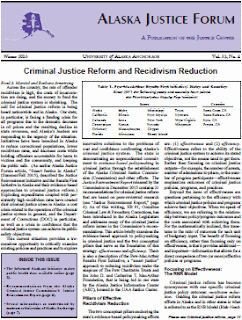 The Winter 2016 issue of the Alaska Justice Forum features articles on approaches to evidence-based criminal justice reform and recidivism reduction in Alaska, sexual misconduct and sexual violence as perceived by students at University of Alaska Anchorage, and an initiatve to make Alaska and national public health data available online.
The 12-page issue contains the following articles:
"Criminal Justice Reform and Recidivism Reduction" by Brad A. Myrstol and Barbara Armstrong
This article briefly examines the evidence-based approach to policymaking in criminal justice. The article also describes the Pew-MacArthur Results First Initiative, a “smart justice” approach to reducing recidivism that is being led in Alaska by the Alaska Justice Information Center (AJiC), housed in the UAA Justice Center."Justice Reinvestment Report"
This article summarizes the Alaska Criminal Justice Commission's recommendations for criminal justice reform in Alaska included in the Commission's Justice Reinvestment Report released in December 2015."Sexual Misconduct: How Do UAA Students Define It?" by Lindsey Blumenstein
This article describes a qualitative study undertaken to explore how UAA students identify sexual violence and sexual misconduct, as well as the concept of consent."Informed Alaskans Initiative: Public Health Data in Alaska" by Barbara Armstrong
This article describes the Informed Alaskans Initiative launched by the Alaska Division of Public Health to make state and national public health data available online.
Thursday, November 5, 2015
Khristy Parker, AJSAC researcher, interviewed by Alaska Dispatch News about Fact Sheet on DOC post-conviction incarcerated population 2005-2014
 Khristy Parker, Alaska Justice Statistical Analysis Center (AJSAC) researcher, was interviewed by Jerzy Shedlock of the Alaska Dispatch News about the recent Fact Sheet on the Alaska Department of Corrections post-conviction incarcerated population 2005-2014.
Click here to read the article:
"Number of convict women in Alaska prisons up as overall population drops," by Jerzy Shedlock. Alaska Dispatch News. 02 Nov 2015.

Monday, November 2, 2015
AJSAC Fact Sheet: Alaska Department of Corrections: Post-Conviction Incarcerated Population, 2005–2014
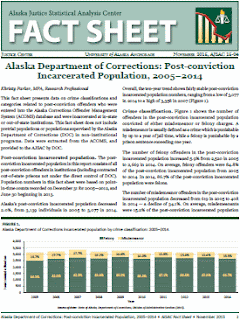
The fact sheet is by Khristy Parker of the Alaska Justice Statistical Analysis Center (AJSAC).
Tuesday, September 8, 2015
Alaska Justice Statistical Analysis Center releases fact sheet on Alaska Department of Corrections institutional populations from 2005 to 2014
 The most recent issue of the AJSAC Fact Sheet
presents data on institutional populations supervised by the Alaska
Department of Corrections (DOC).
The most recent issue of the AJSAC Fact Sheet
presents data on institutional populations supervised by the Alaska
Department of Corrections (DOC).The report, "Alaska Department of Corrections: Institutional Populations, 2005–2014," describes DOC institutional populations based on their status in the criminal justice system from 2005 to 2014. Probation and parole populations are excluded unless they have violated the terms of their release and been returned to incarceration; individuals on non-criminal holds are also excluded. Data was extracted from the Alaska Corrections Offender Management System (ACOMS).
The fact sheet is by Khristy Parker of the Alaska Justice Statistical Analysis Center (AJSAC).
Monday, June 22, 2015
Alaska Justice Statistical Analysis Center releases fact sheet on Alaska Department of Corrections admissions and population from 2004 to 2013
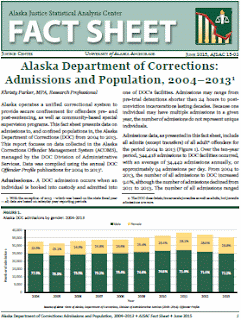
The report, "Alaska Department of Corrections: Admissions and Population, 2004–2013," focuses on incarcerated populations and rates in both in-state and out-of-state facilities, as well as populations and rates in special supervision programs such as Community Residential Centers (CRCs) and electronic monitoring (EM). Data was compiled using the annual DOC Offender Profile publications for 2004 to 2013.
The fact sheet is by Khristy Parker of the Alaska Justice Statistical Analysis Center (AJSAC). The AJSAC is housed within the UAA Justice Center and publishes Fact Sheets addressing various crime and criminal justice topics.
Friday, March 6, 2015
Dr. Allen Ault speaks about his "40 Years in Corrections" for National Criminal Justice Month
 |
| Dr. Ault stresses a point during his presentation. |
 This event was sponsored by the Justice Center, the Pre-Law Society, and the Justice Club as part of National Criminal Justice Month. Dr. Troy Payne and Prof. Jason Brandeis, J.D., are the Justice Center faculty advisors for this event. Our thanks to Rich Curtner, an adjunct faculty member at the Justice Center, and Alaskans Against the Death Penalty for bringing Dr. Ault to Alaska and making possible Dr. Ault’s presentation at this event.
A podcast and Dr. Ault's Powerpoint presentation are on the Justice Center website.
Media mention
- "Ex-Dept. Of Justice Official to Alaska Students: We Can Do Better" by John Aronno. Alaska Commons, 3 Mar 2015.
 |
| L to r: Prof. Jason Brandeis, J.D.; Dr. Troy Payne; Dr. Allen Ault; Camilla Hussein, Pre-Law Society President; Rich Curtner, Adjunct Faculty, and Chair, Alaskans Against the Death Penalty |
Friday, September 26, 2014
Spring/Summer 2014 issue of the Alaska Justice Forum
 The Spring/Summer 2014 issue of the Alaska Justice Forum
includes articles on marijuana laws and policies, homelessness statistics for Alaska and the U.S., the newly-created Alaska Criminal Justice Commission, and the Alaska Court System's Early Resolution Program (ERP) for family law cases.
The 20-page
issue includes the following articles:
The Spring/Summer 2014 issue of the Alaska Justice Forum
includes articles on marijuana laws and policies, homelessness statistics for Alaska and the U.S., the newly-created Alaska Criminal Justice Commission, and the Alaska Court System's Early Resolution Program (ERP) for family law cases.
The 20-page
issue includes the following articles: "Shifting Marijuana Laws and Policies: Implications for Alaska" by Jason Brandeis
Marijuana regulation continues to be a pressing criminal justice and social policy issue both in Alaska and across the nation. A ballot measure that would legalize, tax, and regulate marijuana in Alaska will be before the state’s voters at the November 2014 general election. This article summarizes Alaska’s current marijuana laws, identifies recent changes to other state laws and federal policies related to marijuana use and possession, and discusses the impact of those changes on Alaska’s marijuana laws."The Homeless: Who and How Many?" by Barbara Armstrong and Sharon Chamard
Across the nation in both rural and urban areas, public and private agencies work to provide services for homeless people. One of the biggest challenges is collecting data about homeless individuals: how many people are homeless, who they are, what services they need most, and how long they have been homeless. This article looks at reports from 2012, 2013, and 2014 on estimates of homelessness in the U.S. and Alaska, the subpopulations of homeless individuals, and the various definitions of homelessness. References for sources cited are provided. Web supplements provide more detailed tables and an expanded bibliography of resources on homelesseness."The Alaska Criminal Justice Commission: A Legislative Call for Action" by Mary Geddes
With its enactment of Senate Bill 64 during the 2013–2014 legislative session, the Alaska Legislature created the Alaska Criminal Justice Commission. This article describes the work of the commission, which is charged with evaluating and making recommendations “for improving criminal sentencing practices and criminal justice practices, including rehabilitation and restitution” over a three-year period. An accompanying sidebar describes other provisions of SB 64, the omnibus crime bill."Early Resolution for Family Law Cases in Alaska’s Courts" by Stacey Marz
The Early Resolution Program (ERP), the first program of its kind in the nation, was developed by the Alaska Court System's Family Law Self-Help Center to provide self-represented litigants in family law cases with free legal assitance and mediation to help resolve issues and reach settlements without protracted court trials. This article discusses the ERP's goals and development, describes how cases are screened and processed, and presents ERP statistics though August 2014. An accompanying sidebar provides a program timeline, and a web supplement outlines how attorneys and judges approach various issues in a case at an Early Resolution Program (ERP) hearing."New Faculty"
Professor Lindsey Blumenstein has joined the Justice Center faculty as of the Fall 2014 semester.
Wednesday, February 19, 2014
Fall 2013/Winter 2014 issue of the Alaska Justice Forum

"Collateral Consequences and Reentry in Alaska: An Update" by Deborah Periman
This article describes recent efforts at the national level to ameliorate the public costs of unnecessary collateral consequences, summarizes the array of statutory and regulatory impediments faced by released offenders in Alaska, and highlights legislative efforts in Alaska to improve community safety and public health by facilitating prisoner reintegration and reducing rates of recidivism."The Second Chance Act in Alaska" by Deborah Periman
This article describes impacts in Alaska of the Second Chance Act of 2007, which was enacted to address problems posed by the growing number of adults and juveniles released from incarceration and returned to their communities."Employment Barriers and Domestic Violence" by Deborah Periman
Research has found the link between perpetrator unemployment and domestic violence to be so significant that experts conclude any effective domestic violence prevention strategy must address unemployment and male poverty."Prison Visitation Policies in the U.S. And Alaska"
This article examines prison visitation in Alaska and nationally based on a 2012 survey of prison visitation policies for all 50 states and in the federal prison system."Questions from Prison Visitation Policies: A Fifty State Survey"
A summary of Alaska information from a national survey of prison visitation policies."Alaska Prisoner Reentry Task Force Update"
The Alaska Prisoner Reentry Task Force, a sub-committee of the Criminal Justice Working Group (CJWG), focuses on promoting the goal that individuals released from incarceration do not return to custody. This article presents an update on progress on Alaska's Five-Year Prisoner Reentry Strategic Plan, 2011–2016, which was released by Task Force in February 2011."In Memoriam"
Dr. Nancy E. Schafer, a member of the Justice Center faculty from 1983 to 2002, died in September 2013 after an illness. Research publications and papers by Dr. Schafer can be viewed at the Justice Center website."New Staff"
Khristy Parker, Justice ‘08 and MPA (Criminal Justice emphasis) ‘13, has joined the staff of the Alaska Justice Statistical Analysis Center (AJSAC) as a research professional."Recent Faculty Publications"
Recent publications of UAA Justice Center faculty.
Tuesday, April 23, 2013
Collateral Consequences Work Group forms to look at reentry barriers for offenders
 The newly formed Collateral Consequences Work Group held its first organizational meeting in April. The work group was initiated to assist the bipartisan efforts of Senators John Coghill (R), Fred Dyson (R), Johnny Ellis (D), and Hollis French (D) to reduce recidivism in Alaska.
The work group has been asked to look for public safety-oriented strategies to mitigate statutory and regulatory barriers to offender reentry. Former Department of Corrections Deputy Commissioner Carmen Gutierrez organized the work group and serves as chair.
Individuals convicted of certain offenses are barred from particular jobs and licenses, and may be prohibited from receiving specific types of government benefits, even though the offender has completed his/her sentence. These barriers to reentry to the community are a grave concern. Alaska currently has 492 statutes and regulations that create a collateral consequence for an offender.
Because of the bipartisan effort in Alaska, the director of the National Inventory of Collateral Consequences of Conviction Project is set to next inventory Alaska's 492 statutes and regulations.
Congress directed the National Institute of Justice to collect and study collateral consequences in all U.S. jurisdictions, and NIJ selected the American Bar Association (ABA) Criminal Justice Section to perform the necessary research and analysis. The results are now being made available through an interactive website. Collateral consequences for seventeen states and the federal system have been uploaded to the website. The project target completion date is April 2014.
The goal of the work group is outlined in the Task Force's Five-Year Prisoner Reentry Strategic Plan, 2011-2016: examine current employment restrictions and other collateral consequences for offenders, identify alternatives as recommendations to more carefully tailor restrictions to public safety that are appropriate to Alaska, and address ways of reducing liability of employers and landlords.
Work group members include:
- Carmen Gutierrez, Chair
- Deb Periman, UAA Justice Center
- Mary Geddes, former Assistant U.S. Federal Defender
- Susie Dosik, Alaska Judicial Council
- Doug Wooliver, Alaska Court System
Prof. Periman outlined some of the collateral consequences facing offenders in Alaska in a 2011 Alaska Justice Forum article, "Prisoner Reentry and the Uniform Collateral Consequences of Conviction Act."
Tuesday, March 12, 2013
Representatives from institutional and community corrections speak at National Criminal Justice Month event
 |
| Prof. Jason Brandeis, J.D., introduces the panel. |
"Working in Institutional and Community Corrections," held March 1, was the first in a series of 3 presentations for National Criminal Justice Month.
Panelists were Anthony Piper, Alcohol Safety Action Program (ASAP) Program Manager, Alaska Department of Health and Social Services; Rebecca Tozer, Probation Officer II, Alaska Department of Corrections; and Lt. Scott Dial & Sgt. Rodney Ramirez, Alaska Department of Corrections. The program focused on goals of corrections programs, common misconceptions of work in corrections, differences in probation and parole, training required, most useful college courses for students to take, and career paths in the field of corrections.
This is the 3rd annual series of presentations focusing on criminal justice issues for National Criminal Justice Month. The Justice Center, Justice Club, and the Pre-Law Society are co-sponsors of this event.
All events are free and open to UAA students, faculty, staff, and the public. Click here for information on all the presentations for National Criminal Justice Month.
 |
| L to r: Daniel Reinhard, Justice Club president; Anthony Piper, ASAP Program Manager; Probation Officer Rebecca Tozer, AK Dept.of Corrections (DOC); Sgt. Rodney Ramirez, DOC; Lt. Scott Dial, DOC; Prof. Jason Brandeis, J.D., Justice Club co-advisor. |
Friday, March 1, 2013
Don't miss tonight's panel on working in institutional and community corrections - LIB 307!

Working in Institutional and Community Corrections
- Anthony Piper, Alcohol Safety Action Program (ASAP) Program Manager, Alaska Department of Health and Social Services
- Rebecca Tozer, Probation Officer II, Alaska Department of Corrections
- Lt. Scott Dial & Sgt. Rodney Ramirez, Alaska Department of Corrections
Location: UAA/APU Consortium Library, LIB 307
Parking is free in the library surface lots.
All events are free and open to UAA students, faculty, staff, and the public.
This is the 3rd annual series of presentations focusing on criminal justice issues for National Criminal Justice Month. The Justice Center, Justice Club, and the Pre-Law Society are co-sponsors of this event.
Click here for information on all the presentations for National Criminal Justice Month.
Monday, February 25, 2013
Fall 2012/Winter 2013 issue of the Alaska Justice Forum

Articles:
"Moving Beyond Brands: Integrating Approaches to Mediation" by Brian Jarrett
Mediation has become a competition among brands vying for distinction based more on market concerns than genuine difference. This is not a positive development for a professional field of endeavor. Mediation has much more to offer than competing claims of superiority that attempt to deride and disparage the competition. This article, which is written from a sociological viewpoint, challenges these claims and suggests that the mediation community should develop instead a broader integrated approach to mediation that is pragmatic, flexible, open-source, and based on a robust theoretical foundation."Alaska Correctional Populations 2011"
This article provides a description of Alaska correctional populations in 2011 based upon the Alaska Department of Corrections 2011 offender profile. At the end of 2011, there was a total of 5,727 offenders in prisons, jails, community residential centers, treatment centers, or offsite monitoring programs, and an additonal 5,951 offenders on probation or parole."Trends in Alaska Offender Demographics"
An aging offender population, a change in the proportion of offenders sentenced for violent versus non-violent crimes, an increase in offenders in community residential caenters and offiste programs, and an increase in average length of stay for felony and misdemeanor convictions are among the trends in Alaska offender demographics as described in the Alaska Department of Corrections 2011 offender profile."U.S. Correctional Populations 2011"
At year-end 2011, 1,504,150 offenders were incarcerated in the U.S. under federal or state jurisdiction, and an additional 735,601 individuals were in custody under local jurisdiction, for a total of 2,239,751 incarcerated individuals in the U.S., according to the Bureau of Justice Statistics (BJS). The U.S. corrections population in 2011 declined for the third consecutive year, but the U.S. continues to lead all other nations in both the rate of incarceration and the actual number of incarcerated persons."Alaska Prisoner Reentry Task Force Update"
The Alaska Prisoner Reentry Task Force, a sub-committee of the Criminal Justice Working Group (CJWG), focuses on promoting the goal that individuals released from incarceration do not return to custody. This article presents an update on progress on the The Alaska Five-Year Prisoner Reentry Strategic Plan, 2011–2016, which was released by Task Force in February 2011."Staff Changes"
Charlotte Titus has joined the Justice Center staff as office manager.
Panel of experts speak on working in Alaska corrections system on March 1 for National Criminal Justice Month

Working in Institutional and Community Corrections
- Anthony Piper, Alcohol Safety Action Program (ASAP) Program Manager, Alaska Department of Health and Social Services
- Rebecca Tozer, Probation Officer II, Alaska Department of Corrections
- Lt. Scott Dial & Sgt. Rodney Ramirez, Alaska Department of Corrections
Location: UAA/APU Consortium Library, LIB 307
Parking is free in the library surface lots.
All events are free and open to UAA students, faculty, staff, and the public.
This is the 3rd annual National Criminal Justice Month series of presentations focusing on criminal justice issues.
Click here for information on all the presentations for National Criminal Justice Month.
Monday, February 11, 2013
Don't miss this 3rd annual series of events for National Criminal Justice Month in March!

All events are free and open to UAA students, faculty, staff, and the public. The series will be held in the UAA/APU Consortium Library, 3rd floor, LIB 307. Parking is free in the library surface lots.
Friday, March 1, 2013 – 6:30 – 7:30 p.m.
Working in Institutional and Community Corrections
- Anthony Piper, Alcohol Safety Action Program (ASAP) Program Manager, Alaska Department of Health and Social Services
- Rebecca Tozer, Probation Officer II, Alaska Department of Corrections
- Lt. Scott Dial & Sgt. Rodney Ramirez, Alaska Department of Corrections
Gideon v. Wainwright: Celebrating 50 Years of Public Defenders for Criminal Offenses and a Proposal for a “Civil Gideon”
- Prof. Richard Curtner, Federal Defender, Federal Defender’s Office
- Michael Schwaiger, Assistant Public Defender, Alaska Public Defender Agency
- Nikole Nelson, Executive Director, Alaska Legal Services Corporation
Tribal Courts in Alaska: Past, Present, and Future
- Walt Monegan, Alaska Native Justice Center CEO, Moderator
- Kevin Illingworth, Tribal Management Program Head and Assistant Professor, Interior-Aleutians Campus, UAF
- Lisa Jaeger, Tribal Government Specialist, Tanana Chiefs Conference
- Natalie Landreth, Staff Attorney, Native American Rights Fund
- Magistrate Judge Christopher McLain, Alaska Court System


Monday, April 2, 2012
Alpha Phi Sigma, criminal justice honor society, invites State of Alaska Department of Corrections recruiter to speak to students on April 10

Day/Time: Tuesday, April 10, 4:00 p.m.
Location: SSB 224
If you have any questions, please contact Dr. Marny Rivera, Alpha Phi Sigma Co-Advisor at 786-1126 or email her mschaef7@uaa.alaska.edu.
Tuesday, November 22, 2011
Summer/Fall 2011 issue of the Alaska Justice Forum

Immigrants in Alaska—Authorized and Unauthorized by Antonia Moras
The immigration of most foreign-born residents of Alaska has occurred legally under established laws and regulations. However, the picture of immigration in Alaska—both authorized and unauthorized—differs in some details from the rest of the country as a whole. According to census figures based on an average over the 5-year period of 2005–2009, immigrants from Asian countries formed a greater proportion of the foreign-born population than they did in the U.S. overall. Over one-half of immigrants to Alaska came from Asia. In the country as whole, immigrants from the Americas constitute over 55 percent of the foreign-born, with Mexico being by far the most common country of origin. The article also discusses the increase in and estimated number of unauthorized immigrants in the U.S. and Alaska, and place of birth of and labor force participation of unauthorized immigrants. Includes notes on data sources and a bibliography of articles on immigration and noncitizens that have appeared in the Alaska Justice Forum.Enforcement of Immigration Laws by Antonia Moras
Although there has been increasing involvement by state and local law enforcement, and more politicization of immigration issues at the state and local level, the federal government still has primary responsibility for enforcement of the nation’s immigration laws. Despite relatively few cases, the adjudication of immigration cases in Alaska has slowed dramatically over the last decade, as it has elsewhere. This article also examines immigrant detention Alaska, immigration court proceedings, and the lengthy time for an immigration proceeding, and the enormous backlog of cases.PACE: A Pilot Project for Probation Violators in Anchorage
Probation Accountability and Certain Enforcement (PACE), based on the Hawaii Court HOPE model, is a pilot project introduced in the Anchorage Superior Court in July 2010. This article presents findings and recommendations from a recent Alaska Judicial Council evaluation of the project, which seeks to deal with probation violations quickly with immediate imposition of a sanction.Alaska's Five-Year Prisoner Reentry Strategic Plan, 2011–2016
The Five-year Prisoner Reentry Strategic Plan, 2011-2016, released this year by the Alaska Prisoner Reentry Task Force, presents a comprehensive overview of the issues surrounding successful prisoner reentry in Alaska, and makes recommendations for implementation of the plan. Includes a bibliography of resources on prisoner reentry and justice reinvestment.A Brief Look at VPSOs and Violence Against Women Cases
This article looks at a study of sexual assault (SA) and sexual assault of a minor (SAM) cases reported to Alaska State Troopers in 2003 and 2004 when the first responder was a local paraprofessional police officer— a Village Public Safety Officer (VPSO), Village Police Officer (VPO), or Tribal Police Officer (TPO). The probability of a case being referred to the Alaska Department of Law, of being accepted for prosecution, and resulting in a conviction was greater in most types of SA and SAM cases reported to the Alaska State Troopers when paraprofessional police officers were involved as first responders. Past studies have also demonstrated the positive impact of paraprofessional police in rural Alaska. A brief description of the VPSO program and current VPSO staffing is given. Includes a bibliography of articles on Village Public Safety Officers (VPSOs) and paraprofessional police that have appeared in the Alaska Justice Forum and elsewhere.U.S. State and Local Law Enforcement Agencies Census 2008 by Bureau of Justice Statistics
Over 1.1 millions persons were employed full-time by state and local law enforcement in the U.S. in 2008, according to the most recent census of state and local law enforcement agencies from the Bureau of Justice Statistics. Of that number, 765,000 were sworn personnel – defined as those with general arrest powers. In 2008, Alaska had 1,298 sworn personnel in 50 state and local law enforcement agencies, including 274 sworn officers of the Alaska State Troopers.Faculty Notes
Marny Rivera, Justice Center faculty member, has been awarded tenure and been promoted to Associate Professor.Recent Justice Center Faculty Publications
A bibliography of recent publications by Justice Center faculty.
Monday, April 4, 2011
Winter 2011 issue of the Alaska Justice Forum
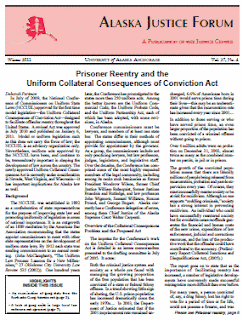
"Prisoner Reentry and the Uniform Collateral Consequences of Conviction Act" by Deborah Periman
The Uniform Collateral Consequences of Conviction Act, designed to facilitate offender reentry throughout the United States, is model legislation approved by he National Conference of Commissioners on Uniform State Laws (NCCUSL). Model or uniform legislation does not carry the force of law, but are important in shaping the development of law across the country. The newly approved Uniform Collateral Consequences Act is currently under consideration in Nevada, West Virginia, and Wisconsin. This article describes its provisions and its implications for Alaska. A bibliography for further reading is also included."Gangs: National Data and the Fairbanks Gang Assessment" by Khristy Parker and Shea Daniels
The Fairbanks Gang Assessment, completed in 2010, is the first structured study of gang activity in Alaska. This article examines gang member demographics, gang membership motivation, problems caused by gangs, and possible solutions to gang problems in Fairbanks North Star Borough. Selected national gang data and trends are also examined."Legal Definitions of Gang and Gang Crime"
Legal definitions of gang and gang crime vary among federal and state jurisdictions, which are described in this brief article."Gang Units in Local Law Enforcement Agencies"
This article summarizes a recent report from the Bureau of Justice Statistics on 365 of the nation’s large (100 or more sworn officers) police departments and sheriffs’ offices with a unit focusing on gang crime. Currently there are no dedicated gang units in any Alaska law enforcement agencies. A brief bibliography on gangs is included.
Subscribe to:
Posts (Atom)