Showing posts with label ACADEMIC. Show all posts

Tuesday, November 13, 2018

Legal Studies program seeking an Assistant Professor of Justice

The Justice Center's Legal Studies program is searching for an Assistant Professor of Justice

This tenure-track position is responsible for teaching and providing professional service to the  University, to the profession/discipline, and to the community. Incumbent is expected to teach  undergraduate legal studies courses on a variety of substantive and skills-based topics in legal studies and to serve as liaison with the Alaska legal community, developing career, service, and  internship opportunities for students. The standard instructional workload is 4 courses per semester.

Requirements:
  • Juris Doctor degree from a law school approved by the American Bar Association.
  • Member in good standing of the Alaska Bar Association or the bar association of another state.
  • Experience practicing criminal law is preferred, but not required.
  • Seeking applicants that reflect the increasing diversity present in our community student body.
See the full job posting at the Careers at UAA website.

For more information contact the UAA Justice Center at (907) 786-1810.

Wednesday, November 7, 2018

Homelessness and Crime (JUSTA490-001) examines social problems associated with homelessness, including crime and victimization

Homelessness and Crime (JUSTA490-001) flyer
What are best practices to move people out of homelessness? How do we deal with crime and other social problems associated with homelessness? How can we reduce the very high rates of victimization among homeless people? Who becomes homeless and why?

These question will be examined in Homelessness and Crime (JUSTA490-001). This Spring 2019 elective course will be held Mondays and Wednesdays from 10:00 to 11:15 AM.

  • CRN: 37056 (Note: There are multiple sections of JUST A490. Be sure to use the right CRN for this course!)
  • Catalog description: JUST A490 is a variable topics course which addresses current issues. Topics of national interest as well as those peculiar to Alaska will be included. 
  • Special note: JUST A490 may be repeated once for credit with a change in subtitle. 
  • Prerequisites: JUST A11O with Junior or Senior standing (exceptions made upon instructor approval). Ask about an override if you have a Social Science GER other than JUST A110.

For more information, contact Prof. Sharon Chamard at sechamard@alaska.edu or 786-1813.

Registration for Spring 2019 courses begins on November 12 for seniors and November 13 for juniors.

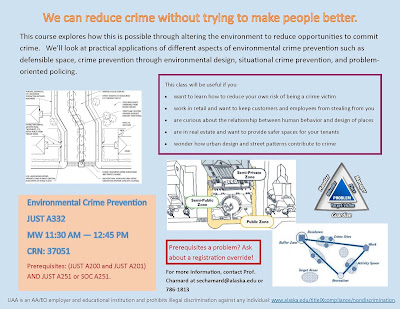
Environmental Crime Prevention (JUST A332) explores how to reduce crime by altering the environment

Environmental Crime Prevention (JUST A332) flyer
We can reduce crime without trying to make people better. The Spring 2019 course Environmental Crime Prevention (JUSTA332) explores how this is possible through altering the environment to reduce opportunities to commit crime. We’ll look at practical applications of different aspects of environmental crime prevention such as defensible space, crime prevention through environmental design, situational crime prevention, and problem-oriented policing.

This class will be useful if you

  • want to learn how to reduce your own risk of being a crime victim;
  • work in retail and want to keep customers and employees from stealing from you;
  • are curious about the relationship between human behavior and design of places;
  • are in real estate and want to provide safer spaces for your tenants;
  • wonder how urban design and street patterns contribute to crime.

This elective course will be held Mondays and Wednesdays, 11:30 to 12:45 PM.

  • CRN: 37051
  • Catalog description: Examines the theoretical background to opportunity— reducing in environmental crime prevention. Explores the application and implementation of crime prevention through environmental design, defensible space, and problem-oriented policing. Illustrates the practical and policy difficulties of environmental crime prevention through the use of case studies and field work.
  • Special note: JUST A320 recommended
  • Prerequisites: JUST A200 and JUST A201 and (JUST A251 or SOC A251).

Prerequisites a problem? Ask about a registration override!

For more information, contact Prof. Sharon Chamard at sechamard@alaska.edu or 786-1813.

Registration for Spring 2019 courses begins on November 12 for seniors, November 13 for juniors, and November 14 for sophomores.

Tuesday, November 6, 2018

Compensation for disabling injuries focus of course on Torts, Worker’s Compensation, & Insurance Law (LEGL/JUST A380)

Torts, Worker’s Compensation, & Insurance Law (LEGL/JUST A380) flyer
There are 26 million disabling injuries every year in the U.S.—and the economic cost of those injuries reach into the hundreds of billions. Why is the compensation system for such injuries so expensive, burdensome, inadequate, and slow? Does it work to deter unsafe conduct and products? Is it possible to be both fair and administratively efficient? Torts, Worker’s Compensation, & Insurance Law (LEGL/JUST A380) will examine these questions.

Studying tort law involves a lot more than learning doctrinal rules—it integrates a fundamental understanding of the American legal system. It’s also a great way to learn some professional skills in a true-to-life setting.

This Spring 2019 elective will be held Mondays and Wednesdays from 5:30 to 6:45 PM.
  • CRN: 37060
  • Catalog description: Analyzes nature and function of the law of torts, workers' compensation, and liability insurance in the United States, as well as the role of the nonlawyer legal professional in tort litigation and workers' compensation claims. Includes ethical issues in tort, workers' compensation, and insurance cases. Practice in Alaska and the development of professional skills are emphasized. Legal specialty course.
  • Registration Restrictions: Completion of LEGL A356 is strongly recommended.
  • Prerequisites: LEGL A101 with a minimum grade of C and LEGL A215 with a minimum grade of C.
If course prerequisites are a problem, ask about a registration override.

For more info, contact Prof. Kristin Knudsen at kknudsen@alaska.edu or 786-4885.

Registration for Spring 2019 courses begins on November 12.

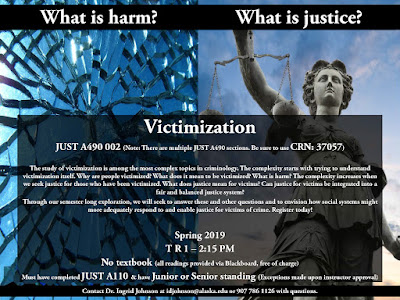
Victimization (JUSTA490-002) examines how we might better respond to and enable justice for victims of crime

Victimization (JUSTA490-002) flyer
The study of victimization is among the most complex topics in criminology. The complexity starts with trying to understand victimization itself. Why are people victimized? What does it mean to be victimized? What is harm? The complexity increases when we seek justice for those who have been victimized. What does justice mean for victims? Can justice for victims be integrated into a fair and balanced justice system?

Through our semester-long exploration in Victimization (JUSTA490-002), we will seek to answer these and other questions and to envision how social systems might more adequately respond to and enable justice for victims of crime.

This Spring 2019 elective course will be held Tuesdays and Thursdays from 1:00 to 2:15 PM. There will be no textbook — all readings will be provided via Blackboard, free of charge.

  • CRN: 37057 (Note: There are multiple sections of JUST A490. Be sure to use the right CRN for this course!)
  • Catalog description: JUST A490 is a variable topics course which addresses current issues. Topics of national interest as well as those peculiar to Alaska will be included. 
  • Special Note: JUST A490 may be repeated once for credit with a change in subtitle. 
  • Prerequisites: JUST A11O with Junior or Senior standing (exceptions made upon instructor approval)

Contact Dr. Ingrid Johnson at idjohnson@alaska.edu or (907) 786-1126 with questions.

Registration for Spring 2019 courses begins on November 12 for seniors and November 13 for juniors.

Course on Probation, Parole and Community Corrections (JUST A445) explores supervision of offenders in the community

Probation, Parole and Community Corrections (JUST A445) flyer
Community corrections programs oversee offenders outside of jail or prison, and are administered by agencies or courts with the legal authority to enforce sanctions. Community corrections includes probation — correctional supervision within the community rather than jail or prison — and parole — a period of conditional, supervised release from prison.

Probation, Parole and Community Corrections (JUST A445) will examine how the system of probation and parole developed, practices and methods of supervision of probationers and parolees, and programs for the reentry and reintegration of offenders into the community.

This Spring 2019 elective will be held Mondays and Wednesdays from 1:00 to 2:15 PM.
  • CRN: 31502
  • Catalog description: Covers the history and development of probation and parole, including notions of rehabilitation, reentry and reintegration. Investigates evidence-based standards, and numerous and diverse types of supervision, treatment, control, restoration and supportive programs for criminal offenders within the community.
  • Prerequisites: JUST 110 & Junior/Senior Standing
Questions? Contact Dr. Rita Augustyn at rjaugustyn2@alaska.edu or 907-786-4302.

Registration for Spring 2019 courses begins on November 12 for seniors and November 13 for juniors.

Police–Community Relations (JUST A434) explores the relationships between police and the many “publics” they serve

Police–Community Relations (JUST A434) flyer
At the heart of democratic governance are notions of limited authority, equality before the law, citizen voice and participation, legitimacy, and consent. Due to their unique capacity to use force in order to obtain compliance, and because they represent to embodiment of governmental power and authority to most citizens, the police represent an institutional site of ongoing social and cultural conflict.

In Police–Community Relations (JUST A434), we will explore the nature of the relationships that exist between police and the many “publics” they serve, the factors that influence and give shape to those relationships, and to evaluate the implications of police – community relations for policing a democratic society.

This Spring 2019 elective will be held Mondays and Wednesday from 2:30 to 3:45 PM.

  • CRN: 37054
  • Catalog description: Examines police-community relations in the United States. Explores common conceptions of the police role, from the perspective of both the public and the police themselves, and their impact on police-community relations. Particular emphasis is given to recent developments aimed at ameliorating strained relationships between the police and the various communities they serve. 
  • Registration Restrictions: Senior standing or instructor approval
  • Prerequisites: JUST A110 and JUST A200 and JUST A201

Course prerequisites a problem? Ask about a registration override!

Interested students are encouraged to contact Dr. Brad Myrstol at bamyrstol@alaska.edu or 907.786.1837 with questions.

Registration for Spring 2019 courses begins on November 12 for seniors and November 13 for juniors.

Monday, November 5, 2018

Crime Analysis & Mapping (JUST A432) course gives practical training in common crime analysis tasks used in law enforcement

Crime Analysis & Mapping (JUST A432) flyer
Crime analysis is the practical application of data analysis — and is essential to many modern approaches to solving crime problems. Focused on doing analysis instead of talking about it, Crime Analysis & Mapping (JUST A432), introduces crime analysis tasks based on scenarios commonly faced by crime analysts in law enforcement agencies throughout the US.

The course gives students practical training in ArcGIS for Desktop and Excel, two of the most commonly-used tools in the industry. Enrollment includes a one-year academic license for ArcGIS for installation on your computer.

This Spring 2019 elective course will be held Tuesdays 2:30 to 5:15 PM.
  • CRN: 31500
  • Catalog description: Introduces analytical concepts and computer applications used in the study of temporal and spatial crime data. Demonstrates how these techniques can be used by justice agencies with a special emphasis given to police departments. 
  • Registration restrictions: Completion of all GER Tier 1 (basic college-level skills) courses and • Junior or senior standing
  • Prerequisites: JUST A200 with a minimum grade of C and JUST A201 with a minimum grade of C.
  • Attributes: UAA Integrative Capstone GER.
Contact: Dr. Troy Payne, tpayne9@alaska.edu

Registration for Spring 2019 courses begins on November 12 for seniors and November 13 for juniors.

The Courts (JUST A374) course examines the impact of courts on law, society, and politics

The Courts (JUST 374) flyer
Who really has the power in the court room? How did our courts evolve? What happens as a case moves through the legal system? Where do you find modern research on the courts’ impact on law, society, and politics?

Find out in the Spring 2019 course The Courts (JUST 374), to be held on Tuesdays and Thursdays from 11:30 AM to 12:45 PM.

This is a required course for the Legal Studies B.A., a selective course for the Justice B.A., and a selective course for the Paralegal AAS, PBCT.

  • CRN: 31496
  • Catalog description: Examines the basic components of the U.S. courts with particular emphasis on case processing through the court system and the roles of court actors. Covers the history as well as the current structure and function of the court system and assesses the gap between the ideals and the realities of court processes and practices.
  • Registration restrictions: Junior or senior standing.
  • Prerequisites: JUST A110 or LEGL A101.
For more info, contact Prof. Kristin Knudsen at kknudsen@alaska.edu or 786-4885.

Registration for Spring 2019 courses begins on November 12 for seniors and November 13 for juniors.

Friday, November 2, 2018

Substance Abuse and Crime course (JUST A366) explores relationship between substance abuse and crime

JUST A366 — Substance Use and Crime flyerWhat’s the relation between substance use and crime? What is the underlying mechanism? How does society treat drug-involved offenders?

Find out in the Spring 2019 course Substance Abuse and Crime (JUST A366). This elective course will be held Tuesdays and Thursdays from 2:30 to 3:45 PM.
  • CRN: 37053
  • Catalog description: Introduces the psychopharmacology, physiological effects and schedule classification for substance of abuse. Reviews data estimating extent of use, abuse and related consequences. Provides a critical analysis of the connection between crime and substance use. Differentiates between policy responses to substance use and abuse including prevention, treatment, enforcement and harm reduction.
  • Registration restrictions: Junior or senior standing.
  • Prerequisite: JUST A110.
Contact Dr. Yeungjeom Lee at ylee41@alaska.edu with questions.

Registration for Spring 2019 courses begins on November 12 for seniors and November 13 for juniors.

Wednesday, August 8, 2018

Rural justice course investigates rural crime and criminal justice

What is justice for rural communities? Explore this question (and more) by registering for: Rural Justice (JUST A355), Fall 2018,  Tuesdays and Thursdays  1 to 2:15 PM. Prerequisites: JUST 110 and Junior or Senior standing (Exceptions made upon instructor approval). CRN: 77495. Fulfills Alaska Native-Themed GER. Contact Ingrid Johnson at idjohnson@alaska.edu or 907 786 1126 with questions.
Learn about geographic, social and cultural characteristics of Alaska's rural communities and how these factors can influence the prevalence and nature of crime and criminal justice in the fall 2018 course, Rural Justice (JUST A355). Students will have an opportunity to review competing theories of justice, as well as do a comparative analysis of rural crime and criminal justice in other countries, with emphasis given to other circumpolar nations. Registration restrictions apply. Contact Ingrid Johnson, idjohnson@alaska.edu, 786-1126, with questions.

Tuesday, July 17, 2018

Alumni spotlight: Daniel Reinhard, Justice B.A. 2015, Criminology M.A. 2017, working with AJiC this summer

Daniel Reinhard, Justice B.A. 2015, Criminology M.A. 2017, Simon Fraser University, Vancouver, B.C., is currently enrolled in a Ph.D. program at Texas State University in San Marcos, Texas. This summer, Reinhard is working as a research professional in the Alaska Justice Information Center (AJiC) with Associate AJiC Director and Justice faculty Dr. Troy Payne.

Reinhard's work for AJiC includes compiling Alaska criminal justice data for AJiC Fact Sheets, a series of publications that address crime and criminal justice topics. Reinhard is also assisting with the Law Enforcement and Administrative Statistics (LEMAS) survey in Alaska, and the LEMAS Tribal Community Public Safety Supplement survey. Both are related to better understanding law enforcement staffing and resource needs throughout the state.

As an undergraduate, Reinhard worked on a case study of Town Square Park in downtown Anchorage. He co-authored an article with Dr. Payne,  "The Complexity of Problem-Solving in Urban Parks: A Case Study,"  published in the journal, International Criminal Justice Review, in 2016.

Dr.  Sharon Chamard, Justice faculty, calls Reinhard one of her "best crime prevention students." Last summer, she traveled to Vancouver, B.C.  to be an outside reader and external examiner for Reinhard's master's thesis defense.

Reinhard's area of interest is environmental criminology and international crime prevention. In the fall, he is taking Ph.D. courses at Texas State related to crime mapping, behavioral sciences, and sex offenders, as well as teaching an undergraduate class on crime theory and victimization. When  not taking courses and teaching, Reinhard is working on panhandling and homeless research in Austin, Texas.

Monday, May 7, 2018

Student Independent Study: "Locational Privacy in the data Age in Conflict with the Third-Party Doctrine"

Mark Turberville, Post-Baccalaureate in Paralegal Studies 2018, completed a semester-long independent study with Prof. Ryan Fortson with a a power point presentation on the third-party doctrine, a doctrine that is the subject of  Carpenter v. United States, currently before the United States Supreme Court. In addition to working with Prof. Fortson, Turberville received editorial support from Prof. Kristin Knudsen, Legal Studies Coordinator.
""
Mark Turberville presents on the third-party doctrine, a
paper developed during a semester-long independent study.

Turberville's paper, "Locational Privacy in the Data Age in Conflict with the Third-Party Doctrine," examines the interplay between an individual's right to be free from unlawful search and seizure as guaranteed by the Fourth Amendment of the U.S. Constitution and technological advances that are creating opportunities for collecting personal data unanticipated and unprotected by existing law. In particular, the ability of cell phone technology to gather locational data without the knowledge or consent of the holder of the cell phone.

Turberville traces the evolution of Fourth Amendment protections from the privacy of a person's home, to the privacy of the contents of posted letters, to the content of telephone communications, to the content of email communications, explaining how at each step courts have determined when a person's expectation of privacy is reasonable. In the 1970s, the courts made the delineation that when information is shared with a third party — such as a bank — there is no longer an expectation of privacy and that information may be obtained by police without a search warrant. Since the 1970s, when the third-party doctrine was established, technology has changed greatly and the breadth of information that has been allowed to be collected without full Fourth Amendment protections has also increased dramatically.

For instance, Turberville describes "pinging," where a government agent calls a target cell phone and hangs up without letting it ring. The "ping" allows the agent to collect cell site information and track the location of the phone, although the holder of the phone has taken no action.

Cell tower location information is routinely subpoenaed by law enforcement agencies, according to Turberville. And the volume is high — "From July 2015 to June 2016, for example, AT&T received 75,302 requests for cell phone location information." (p. 15).

But, as Turberville points out, the third-party doctrine is coming under fire from legal scholars and some state courts for leaving too much power in the hands of government. Eleven states have rejected the doctrine, and, based on comments in other decisions and Alaska constitutional protection of privacy, Turberville believes Alaska may reject the doctrine in the future.

In November 2017, the United States Supreme Court heard arguments in Carpenter v. United States, where the defense challenged the use of the third-party doctrine in the long-term surveillance involving smartphone data without a warrant. Data was transmitted and logged even when "location services" on the phone were turned off.

A decision is expected this summer.

Reference

Friday, May 4, 2018

Congratulations 2018 Justice Center Graduates!

Green and gold confetti fills the air above the graduates at a recent UAA commencement ceremony.
As we enter 2018 commencement weekend, join us in congratulating the 33 students who are receiving a degree or certificate in Justice Center programs.

Nineteen students are graduating with degrees in the Justice Program, 18 have earned a B.A. in Justice and one student is receiving a minor in Justice. In the Legal Studies Program, nine students have earned a B.A. in Legal Studies, one student is receiving a Post-Baccalaureate Certificate in Legal Nurse Consultant Paralegal, two students are receiving a Post-Baccalaureate Certificate in Paralegal Studies, and two are receiving a minor in Legal Studies, for a total of 14 degrees completed in Legal Studies.

Special recognition:
Three students are receiving Justice Honors, recognizing the exceptional social research skills developed during their course of study.

Six students have been inducted into Alpha Phi Sigma, the sole Criminal Justice Honor Society, which honors and promotes academic excellence, community service, and educational leadership.
Two students have received Pro Bono Service Honors, recognizing Legal Studies students who volunteer significant time with legal aid organizations.

Bachelor of Arts in Justice
Alyssa Adams
Matthew Anholt
Socorro Corral Canales
Daira Densmore
Tai Kim
Angelina Krasilovskaya
Cody Lewis
Benjamin Matthews
Kenneth McCoy
Joseph McMahon
Amanda Osborne
Bryce Patton (Justice Honors)
Teresa Rath
Brandon Schafer
Benjamin Schmidt (Justice Honors, Alpha Phi Sigma)
Sephria Serrano
Sevy Sheppard (Justice Honors, Alpha Phi Sigma)
Alexis Williams (Alpha Phi Sigma)

Minor in Justice
Ashley Seder

Bachelor of Arts in Legal Studies
Ana Azpilcueta
Joanna Delasse (Pro Bono Service Honors)
Mackenzie Gilpin (Alpha Phi Sigma)
Stacy Gundersen
Christina Isbell
Jennifer Menjivar (Alpha Phi Sigma)
Joseph Morris
Reginald Silvernail
Liza Then (Pro Bono Service Honors, Alpha Phi Sigma)

Post-Baccalaureate Certificate in Legal Nurse Consultant (LNC) Paralegal
Jennifer McCord

Post-Baccalaureate Certificate in Paralegal Studies
Mark Turberville
Kristin Young

Minor in Legal Studies
Maria Burroughs
Kaleb Gibertoni

Student independent study: "The Mental Illness and Substance Abuse Among Attorneys"

Mackenzie Gilpin, B.A. Legal Studies 2018, completed a semester-long independent study with Prof. Ryan Fortson with a a Powerpoint presentation on her work this week. In addition to Prof. Fortson, Gilpin received editorial support from Prof. Kristin Knudsen, Legal Studies Coordinator.
Left to right: Mackenzie Gilpin, Prof. Ryan Fortson,
 and Mark Turberville following independent study presentations

Gilpin's paper, "The Mental Health and Substance Abuse Among Attorneys," investigates the relatively high prevalence of mental health issues and substance abuse among attorneys as compared to the general population, possible causes, and suggestions for improvement. She draws upon multiple studies, including one conducted by Patrick Krill in 2016.

Gilpin reports a correlation between the stress levels experienced during law school and during the practice of law that contribute to the likelihood of attorneys developing mental health issues and substance abuse disorders. Heavy course loads, competition, and lack of feedback from professors, she writes, are some of the reasons for stress in law school. Dissatisfaction with the practice of law, case overloads, and pressure to specialize are reasons Gilpin cites for stress among practicing attorneys.

Mckenzie Gilpin presents on her independent study regarding
mental illness and substance abuse among attorneys.
Lawyers with substance abuse problems are more likely to be involved in disciplinary proceedings that those without substance abuse problems. The American Bar Association has estimated that 50-60% of all disciplinary cases involved substance abuse, according to Gilpin.

After presenting the problem, Gilpin discusses different avenues open to attorneys for addressing the issue. These include seeking treatment and participating in lawyer assistance programs, as well as promoting law firm policies that encourage treatment without endangering job status. Gilpin also suggests that creating a less stressful environment in law school and better communication between students and professors could also reduce the incidence of mental health and substance use disorders among attorneys.

Reference

Tuesday, April 17, 2018

Justice Center is temporarily relocating for Summer 2018

UAA Justice Center is moving temporarily for Summer 2018.
The Justice Center will be temporarily relocating over Summer 2018 due to renovations at the UAA/APU Consortium Library. We will be open as usual— 8:00 a.m. to 5:00 p.m — for the summer session at our summer location at University Center, 130. The University Center is located at 3901 Old Seward Highway (see map below).

In the meantime, the Justice Center is a bit cluttered and messy, with packing boxes scattered about. Please don't let our mess dissuade you from stopping by  if you need to visit with faculty or staff. We are operating as usual, and are here to help in any way we can. Thanks for your patience and understanding while we work our way through this transition.

Wednesday, April 4, 2018

Ret. Judge Sen Tan listens to students argue appellate briefs

Retired Superior Court Judge Sen Tan (at center with black jacket) listened to oral arguments in Prof. Ryan Fortson's Legal Studies Senior Seminar (LEGL 489) on Monday, April 2. Students drafted appellate briefs in the case of State of Alaska v. Alaska Democratic Party (an actual case argued the week prior) and Alaska Republican Party v. State of Alaska (a fictional corollary case). Each student was assigned a single point on appeal to brief and argued this point in front of Judge Tan.

Tuesday, March 6, 2018

Justice Bolger hears student motions in Advanced Litigation class

(L-R) Mark Turberville, David Forthoffer, Jennifer Menjivar, Mackenzie Gilpin,
 Justice Joel Bolger, JoAnna Delasse, Joseph Morris, Kaleb Gibertoni,
Prof. Ryan Fortson, Laura Eagle, Kisung Kang
Alaska Supreme Court Justice Joel Bolger listened to oral arguments by students, provided feedback, and made rulings on the motions during Prof. Ryan Fortson's Trial and Advanced Litigation Processes Class (LEGL 487) on March 1. Students drafted legal memoranda on motions from four fictional scenarios and defended their positions before Justice Bolger. Justice Bolger's participation in the class helped students better understand how judges might react to their work.

Monday, February 19, 2018

ABA approves Legal Studies Program through Aug. 2023

The Justice Center Legal Studies Program has been approved by the American Bar Association (ABA) through August 2023. The Justice Center Legal Studies Program includes:

Bachelor of Arts in Legal Studies
Minor, Legal Studies
Associate of Applied Science, Paralegal Studies
Post-Baccalaureate Certificate, Paralegal Studies
Certificate, Legal Nurse Consultant Paralegal

According to the ABA, "approved programs have demonstrated their high quality education to the lawyers and paralegals in their legal communities."

The Legal Studies Program at UAA and the Paralegal Studies Program at UAF are the only ABA-approved programs in Alaska.

2018 marks the 26th anniversary of ABA approval of UAA's program. Approval is awarded after a rigorous application and assessment process, followed by a thorough site visit by members of the Standing Committee on Paralegals.

The mission of the ABA Standing Committee on Paralegals is to improve the American system of justice by establishing ABA standards for the education of paralegals and by promoting attorneys' professional, effective and ethical utilization of paralegals.

UAA Legal Studies Program graduates can be found working in law firms, state and federal agencies, corporate legal departments, the courts, Native corporations, and the private business sector, contributing to the justice system on the local, state, and federal levels.

Prof. Kristin Knudsen, J.D., M.J.S., is the Legal Studies Program Coordinator.

Friday, February 2, 2018

New APCAAA scholarship — $1000 min.— deadline Feb. 15

APCAAA Scholarship
New Anchorage Police Citizen Academy Alumni Association Scholarship for students enrolled at UAA in Bachelor of Arts in Justice or Legal Studies or Associate of Applied Science in Paralegal Studies. $1,000 per academic year (minimum) is now available. Students must be residents of Alaska and have a 2.0 GPA. The deadline for applying is February 15, 2018. Go to https://www.uaa.alaska.edu/students/financial-aid/scholarships/

(logo) Anchorage Police Citizen Academy Alumni Association (APCAAA)Anchorage Police Citizen Academy Alumni Association (APCAAA) is a non-profit voluntary organization of interested Academy graduates who join to promote and improve community relations, provide continuing education, increase community involvement, and assist and support the Anchorage Police Department.