Showing posts with label Khristy Parker. Show all posts

Monday, February 20, 2017

AJSAC Fact Sheet: Violent Crime Reported in Alaska, 1986–2015

 Violent Crime Reported in Alaska, 1986–2015 (AJSAC Fact Sheet)
The most recent issue of the AJSAC Fact Sheet, "Violent Crime Reported in Alaska, 1986–2015," presents data on violent crimes reported in Alaska from 1986 to 2015 as reported in the Alaska Department of Public Safety publication Crime in Alaska. "Violent crime" is an aggregate category that includes homicide (murder and non-negligent manslaughter), rape, robbery, and aggravated assault offenses reported to police.

From 1986 to 2015, violent crime rates increased in Alaska although the overall crime rate decreased. Homicide and robbery rates declined over the 30-year period, while rape and aggravated assault rates increased from 1986 to 2015 – with aggravated assault acting as the main driver of increases in the violent crime rate over the period. On average, violent crime accounted for 11 percent of all crime reported in Alaska from 1986 to 2015. Aggravated assault accounted for nearly three-quarters, robbery for nearly 15 percent, rape for nearly 13 percent, and homicide for just over one percent of all violent crime reported in Alaska over the period.

The fact sheet is by Khristy Parker, Research Professional, Alaska Justice Statistical Analysis Center (AJSAC). The AJSAC Fact Sheet series addresses various crime and criminal justice topics.

Citation:

Media coverage:

Monday, February 6, 2017

AJSAC Fact Sheet: "Property Crime Reported in Alaska, 1986–2015"

Property Crime Reported in Alaska, 1986–2015. Click through to PDF.
The most recent issue of the AJSAC Fact Sheet, "Property Crime Reported in Alaska, 1986–2015," presents data on property crime in Alaska from 1986 to 2015 as reported in the Alaska Department of Public Safety publication Crime in Alaska. "Property crime" is an aggregate category that includes burglary, larceny-theft, and motor vehicle theft crimes. From 1986 to 2015 the property crime rate in Alaska decreased as the overall crime rate decreased. On average, property crime accounted for two-thirds of all crime in Alaska over the thirty-year period.

The fact sheet is by Khristy Parker, Research Professional, Alaska Justice Statistical Analysis Center (AJSAC). The AJSAC Fact Sheet series addresses various crime and criminal justice topics.

Citation:

Media coverage:

Tuesday, January 10, 2017

Dr. Payne interviewed by Alaska Public Media about homicides in Anchorage

Alaska Public MediaDecember 29, 2016 — A Fact Sheet published by the Alaska Justice Statistical Analysis Center in November 2016 showed a steady decline in Anchorage’s homicide rate from 1986 to 2015. During this period, Anchorage had an average of 17 homicides per year. In 2016, the number of homicides in Anchorage increased to 34. Throughout 2016, as noted by Zachariah Hughes with Alaska Public Media, “news reports from Anchorage have been particularly morbid, with frequent stories about shootings and homicides.”

While the increase in the number of homicides is striking, Dr. Troy Payne, a faculty member of the UAA Justice Center, explained how this could just be a random fluctuation from year to year. At this point, it is difficult to know if there is a systemic repeatable problem that we can apply solutions to. As Dr. Payne explained, additional information will be needed to determine if this is an emerging trend and to understand the causes of these homicides.

Links:

Friday, January 6, 2017

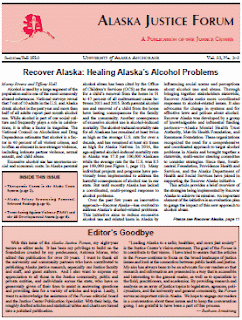
Summer/Fall 2016 issue of the Alaska Justice Forum

Alaska Justice Forum 33(2–3), Summer/Fall 2016
The Summer/Fall 2016 issue of the Alaska Justice Forum presents articles on the Recover Alaska initiative to address Alaska's alcohol-related problems; therapeutic courts in Alaska; findings of the Alaska Judicial Council's analysis of felony sentencing patterns in Alaska in 2012–2013; outcomes of the Teens Acting Against Violence (TAAV) program in Bethel seen through the lens of Search Institute's 40 Developmental Assets; and a farewell from Barbara Armstrong, whose eight-year tenure as editor of the Alaska Justice Forum is ending with this issue.

The 12-page issue includes the following articles:

"Recover Alaska: Healing Alaska's Alcohol Problems" by Marny Rivera and Tiffany Hall

This article provides an overview of the strategies being implemented by the Recover Alaska initiative in its mission to reduce excessive alcohol use and related harm in Alaska by influencing social norms and perceptions about alcohol use and abuse. Includes a list of online resources.

"Editor's Goodbye" by Barbara Armstrong

Barbara Armstrong, editor of the Alaska Justice Forum since 2008, is leaving the Justice Center at the end of December 2016.

"Therapeutic Courts in the Alaska Court System" by Barbara Armstrong

Therapeutic courts — often called “problem-solving courts” or “wellness courts” — have been a growing component of the U.S. court system since the 1990s. This article provides an overview of the development of Alaska Court System therapeutic courts, and describes the 12 therapeutic courts currently operating in Alaska as well as proposed pilot project courts. Includes a bibliography.

"Alaska Felony Sentencing Patterns: Selected Findings" by Teresa White Carns

This article describes selected findings from the Alaska Judicial Council's recently released report Alaska Felony Sentencing Patterns: 2012–2013. The report examines factors associated with felony sentences under new presumptive ranges set by the Alaska Legislature in 2005 and 2006. The study has been used by the Alaska Criminal Justice Commission (ACJC), established by the legislature in 2014 to make recommendations about criminal justice reform and sentencing.

"Teens Acting against Violence (TAAV) and the 40 Developmental Assets" by Khristy Parker

Teens Acting Against Violence (TAAV) is a student-led anti-violence education group formed in 1996 by Tundra Women’s Coalition (TWC) in Bethel, Alaska. This article looks at the program in light of the 40 developmental assets defined by the Search Institute, a nonprofit research program whose framework of strengths and supports for youth development has become an international benchmark. While the developmental assets were not intentionally incorporated in the design of the TAAV program, they are reflected in the program's outcomes.

"New Staff"

Jo Walker has joined the staff of the Justice Center as Academic Program Specialist, and Tristian Monterastelli, has joined the Alaska Justice Information Center (AJiC) staff as a Research Professional.

Friday, December 23, 2016

Summer/Fall 2016 issue of the Alaska Justice Forum released

The Summer/Fall 2016 issue of the Alaska Justice Forum has been released and contains the articles noted below.

Click here to read the PDF of this issue.

Articles:
"Recover Alaska: Healing Alaska's Alcohol Problems" by Marny Rivera and Tiffany Hall
"Therapeutic Courts in the Alaska Court System" by Barbara Armstrong
"Alaska Felony Sentencing Patterns: Selected Findings" by Teresa White Carns
"Teens Acting Against Violence and the 40 Developmental Assets" by Khristy Parker

Monday, November 7, 2016

Khristy Parker interviewed by KTUU Channel 2 News about recent AJSAC Fact Sheet on homicide in Alaska

Khristy Parker, Research Professional, was interviewed by KTUU Channel 2 News about the Alaska Justice Statistical Analysis Center (AJSAC) newly released Fact Sheet, "Homicide in Alaska, 1986-2015."

Homicide in Alaska, 1986–2015The Fact Sheet presents data from the Alaska Department of Public Safety’s annual report Crime in Alaska. Overall, homicide rates have declined steadily during the 30-year period 1986-2015 in Alaska. The Fact Sheet also presents data on homicide weapons used, victim-offender relationships, and clearance rates for homicide crimes during this time period.

Story: "Homicides in Alaska" by Kyle Hopkins. KTUU Channel 2 News, 1 Nov 2016.

Tuesday, November 1, 2016

AJSAC Fact Sheet released - Homicide in Alaska, 1986-2015

Homicide in Alaska, 1986-2015The most recent issue of the AJSAC Fact Sheet, "Homicide in Alaska, 1986-2015," presents data on homicide rates in Alaska over a 30-year period.  Homicides rates were calculated for Alaska (AK), the Municipality of Anchorage (MOA) only, and Alaska - excluding the Municipality of Anchorage (AK-MOA). Data show that homicide rates have declined steadily over the 30-year period.

The Fact Sheet also presents data on the most commonly used weapons in homicides, victim-offender relationships, and clearance rates for homicides.

The fact sheet is by Khristy Parker, Research Professional, Alaska Justice Statistical Analysis Center (AJSAC).

Citation:

Media coverage:

Wednesday, October 19, 2016

Domestic violence research by Justice Center and AJSAC highlighted in Seawolf Monthly

The October 2016 issue of  Seawolf Monthly highlights the domestic violence research, education, and prevention efforts on the UAA campus in the article, "Shining light into the darkness of domestic violence." Seawolf Monthly is an electronic newsletter sent to university and community partners. The article is also noted on the UAA homepage.

The article focuses on research being done by Dr. André Rosay, Justice Center Director; Dr. Lindsey Blumenstein, Justice Center faculty; Dr. Brad Myrstol, Alaska Justice Statistical Analysis (AJSAC) Director; and Khristy Parker, MPA, AJSAC Research Professional.

The story notes:
"The Justice Center’s AndrĂ© Rosay, Lindsey Blumenstein, Brad Myrstol and Khristy Parker have conducted recent research and surveys that more sharply define where and why domestic violence happens in Anchorage and other areas of the state, how it looks in rural versus urban areas, helping lawmakers, Alaska State Troopers and others in the community better understand its nuances so they can more effectively address domestic violence issues.'The intention of [the Alaska Department of Public Safety’s] collaboration with the university is to embrace and learn from the results from the study—a step toward data-driven policymaking and maximizing the use of very limited departmental resources,' the troopers said in a January 2016 press release."

Read the full article here: 
"Shining light into the darkness of domestic violence" by Tracy Kalytiak. Green & Gold News. 17 Oct 2016 and Seawolf Monthly Oct 2016.

Tuesday, September 6, 2016

AJSAC Fact Sheet reports referenced in KTUU Channel 2 News story about crime in Anchorage

Alaska Justice Statistical Analysis Center (AJSAC) Fact Sheets on violent crimes and drug arrests in Alaska were referenced in a recent KTUU Channel 2 news story about crime in Anchorage.   

Dr. Brad Myrstol, Justice Center faculty, is the director of the AJSAC.  Khristy Parker, M.A., Research Professional, is the author of the Fact Sheets.

"Is crime on the rise in Anchorage? A look at the numbers," by Rebecca Palsha. KTUU Channel 2 News. 1 Sep 2016. 


Wednesday, August 3, 2016

AJSAC Fact Sheets included in recent SAC Publication Digest

The Justice Research and Statistics Association (JRSA) has released the online Jan - June 2016 SAC Publication Digest The digest contains abstracts of reports from the nationwide statistical analysis center (SACs).

The volume includes three abstracts for Alaska Justice Statistical Analysis Center (AJSAC) Fact Sheets:

"Alaska Trauma Registry: Trauma Admissions Involving Alcohol or Illegal Drugs, 2014"
Alaska Justice Statistical Analysis Center Fact Sheet 16-01
Author: Khristy Parker, MPA, Research Professional

"Juvenile Justice Referrals and Charges in Alaska, FY 2006–2015"
Alaska Justice Statistical Analysis Center Fact Sheet 16-02
Author: Khristy Parker, MPA, Research Professional

"Alaska Trauma Registry: Trauma Admissions Involving Firearms, 2009–2014"
Alaska Justice Statistical Analysis Center Fact Sheet 16-03
Author: Khristy Parker, MPA, Research Professional

The Justice Research and Statistics Association (JRSA) is a national nonprofit organization dedicated to the use of nonpartisan research and analysis to inform criminal and juvenile justice decision making. JRSA comprises a network of researchers and practitioners throughout government, academia, and the justice community.

Wednesday, April 20, 2016

AJSAC Fact Sheet released -- Alaska Trauma Registry: Trauma Admissions Involving Firearms, 2009-2014

Alaska Trauma Registry: Trauma Admissions Involving Firearms, 2009–2014The most recent issue of the AJSAC Fact Sheet presents data on trauma admissions to all 24 Alaska acute care facilities for injuries involving firearms for the period 2009 - 2014. The report, "Alaska Trauma Registry: Trauma Admissions Involving Firearms, 2009–2014," presents data provided by the Alaska Department of Health and Social Services (DHSS), Department of Public Health, Alaska Trauma Registry.

The fact sheet is by Khristy Parker, Research Professional, Alaska Justice Statistical Analysis Center (AJSAC).

Monday, February 29, 2016

AJSAC releases report on domestic violence and sexual assault/sexual abuse of minor cases

The Alaska Justice and Statistical Analysis Center (AJSAC) recently released a final report, Descriptive Analysis of Domestic Violence and Sexual Assault Incidents Closed by the Alaska State Troopers: 2008-2011.

This report is part of the Alaska Domestic Violence and Sexual Assault Case Processing Project.The results of the project have potential implications in a number of arenas including resource allocation, training for criminal justice professionals, as well as prevention efforts. The report was authored by Brad Myrstol, Ph.D., AJSAC Director, and Khristy Parker, M.P.A., AJSAC Research Professional.

The project is a collaborative effort with the Alaska Department of Public Safety, Alaska State Troopers, and the Alaska Department of Law, and is supported by a research grant award from the U.S. Department of Justice, Bureau of Justice Statistics.

The primary objective of the project is to empirically document the criminal justice case processing and outcomes of sexual assault, sexual abuse of a minor, and domestic violence cases in the state of Alaska. In coming years, the AJSAC intends to expand the project to include additional Alaska police agencies.

Click here to read the press release from the Alaska State Troopers Public Information Office.

Tuesday, February 2, 2016

AJSAC Fact Sheet highlighted on Justice Research and Statistics Association website

The Alaska Justice Statistical Analysis Center (AJSAC) and the 16-01 Fact Sheet — "Alaska Trauma Registry: Trauma Admissions Involving Alcohol or Illegal Drugs, 2014" are in the member spotlight of the Justice Research and Statistics Association (JRSA).
 
The fact sheet presents data from the Alaska Trauma Registry (ATR) on numbers of trauma admissions, patient demographics, and the presence of alcohol or illegal drugs in trauma admissions in 2014. Khristy Parker, Research Professional, is the author of the fact sheet.

JRSA also tweeted about the recent AJSAC Fact Sheet on Alaska Trauma Registry admissions.


The Justice Research and Statistics Association is a national nonprofit organization of state Statistical Analysis Center (SAC) directors, and other researchers and practitioners throughout government, academia, and the justice community who are dedicated to the use of research and analysis to make informed policy and program decisions.

Monday, February 1, 2016

AJSAC Fact Sheet released: Juvenile Justice Referrals and Charges in Alaska, FY 2006–2015

Juvenile Justice Referrals and Charges in Alaska, FY 2006–2015The most recent issue of the AJSAC Fact Sheet presents summary information on referrals made by Alaska law enforcement agencies to the Alaska Division of Juvenile Justice (DJJ) for for state fiscal years 2006–2015. The report, "Juvenile Justice Referrals and Charges in Alaska, FY 2006–2015," presents data on the number of referrals and charges made, and unique individuals referred to DJJ.  Data is drawn from the DJJ Data Trends website.

The fact sheet is by Khristy Parker of the Alaska Justice Statistical Analysis Center (AJSAC).

Thursday, January 21, 2016

AJSAC Fact Sheet released - Alaska Trauma Registry: Trauma Admissions Involving Alcohol or Illegal Drugs, 2014

Alaska Trauma Registry: Trauma Admissions Involving Alcohol or Illegal Drugs, 2014
The most recent issue of the AJSAC Fact Sheet"Alaska Trauma Registry: Trauma Admissions Involving Alcohol or Illegal Drugs, 2014" — presents data from the Alaska Trauma Registry (ATR) on numbers of trauma admissions, patient demographics, and the presence of alcohol or illegal drugs in trauma admissions in 2014.

The fact sheet is by Khristy Parker of the Alaska Justice Statistical Analysis Center (AJSAC).

Monday, November 2, 2015

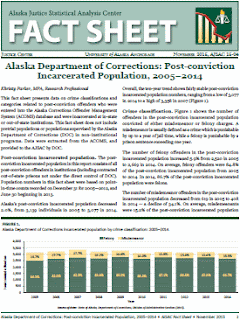
AJSAC Fact Sheet: Alaska Department of Corrections: Post-Conviction Incarcerated Population, 2005–2014

Alaska Department of Corrections: Post-Conviction Incarcerated Population, 2005–2014

The most recent issue of the AJSAC Fact Sheet presents data on post-conviction incarcerated populations supervised by the Alaska Department of Corrections (DOC). The report, "Alaska Department of Corrections: Post-Conviction Incarcerated Population, 2005–2014", focuses on post-conviction incarcerated populations by crime classifications and crime categories overall and within gender.

The fact sheet is by Khristy Parker of the Alaska Justice Statistical Analysis Center (AJSAC).

Friday, October 30, 2015

Teens Acting Against Violence (TAAV) program evaluation highlighted in Alaska Dispatch News

Results from the Teens Acting Against Violence (TAAV) program evaluation conducted by the UAA Justice Center in partnership with the Tundra Women's Coalition (TWC) were highlighted in an article in the Alaska Dispatch News recently. 

Khristy Parker, Research Professional with the Justice Center, was a co-author of the evaluation and presented key findings in Bethel on October 23 at the Tundra Women's Coalition in Bethel.  Dr. AndrĂ© Rosay, Director of the UAA Justice Center; Eileen Arnold, Executive Director of TWC; and Michelle DeWitt, former TWC Executive Director, were also co-authors of the evaluation.

Read the full article here:
"Program targeted at helping Bethel teens earns high marks from alumni" by Lisa Demer. Alaska Dispatch News, 25 Oct 2015.

Tuesday, October 27, 2015

Results from Teens Acting Against Violence (TAAV) evaluation presented in Bethel

Results from the Teens Acting Against Violence (TAAV) program evaluation conducted by the UAA Justice Center in partnership with the Tundra Women's Coalition (TWC) were presented in Bethel on Friday, October 23.

Khristy Parker, Research Professional with the Justice Center, was a co-author of the evaluation and presented key findings in Bethel at the Tundra Women's Coalition office. Dr. André Rosay, Director of the UAA Justice Center; Eileen Arnold, Executive Director of TWC; and Michelle DeWitt, former TWC Executive Director, were also co-authors.

Khristy Parker (l) presents key findings
in Bethel.
Michelle DeWitt spoke about the origins of the TAAV program and the importance of funding a program evaluation, both of which occurred during her tenure as executive director. Eileen Arnold spoke about the organic evolution of TAAV and the shift in the teen population that TAAV serves.

Teens Acting Against Violence (TAAV) is a student-led anti-violence education group that was formed in 1996 by the Tundra Women’s Coalition in Bethel.

The evaluation was two-pronged, focusing on the program effectiveness itself, and the short- and long-term benefits experienced by TAAV alumni over 18 years of age. Participants responded to questions on an online survey.  Overall the results of the evaluation were positive. Click here for the executive summary and key findings.

An event to celebrate the results of the study, as well as TAAV alumni, was held in Bethel on Saturday, October 24, at the Yupiit Piciryarait Cultural Center and featured testimonials from TAAV alumni.

Friday, September 11, 2015

Alaska Justice Statistical Analysis Center Fact Sheet on DOC institutional populations featured in the media

The recent Alaska Justice Statistical Analysis Center (AJSAC) Fact Sheet, "Alaska Department of Corrections Institutional Populations: 2005–2014," has been highlighted in the media:

"Lawmakers ask for big savings from justice reform effort" by Nathaniel Herz with contribution by Jerzy Shedlock. Alaska Dispatch News, 08 Sep 2015. The article notes the data in the Fact Sheet on the increase in the prison population.


"Number of Alaska inmates awaiting trial doubles since 2005" by Mallory Peebles. KTUU Channel 2 News, 09 Sep 2015.


"Sharp rise in female and pre-trial detentions" by Zachariah Hughes. APRN-KSKA Radio, 11 Sep 2105.


The Fact Sheet was also noted by Josh Edge in a morning news brief. APRN-KSKA Radio, , 11 Sep 2105.


"More women are being imprisoned while awaiting trial" by Zachariah Hughes. KTOO Radio Public Media, 14 Sep 2015.

The report, "Alaska Department of Corrections: Institutional Populations, 2005–2014," describes DOC institutional populations based on their status in the criminal justice system from 2005 to 2014. Probation and parole populations are excluded unless they have violated the terms of their release and been returned to incarceration; individuals on non-criminal holds are also excluded. Data was extracted from the Alaska Corrections Offender Management System (ACOMS).

The fact sheet is by Khristy Parker of the Alaska Justice Statistical Analysis Center (AJSAC)