Friday, April 19, 2019

Dr. Johnson seeks study participants for study to improve sexual assault reporting system: Media reports

Alaska SAKI Research on Facebook
KTVA Channel 11 News in Anchorage and the Anchorage Press reported this week on the Alaska SAKI research study being conducted by Dr. Ingrid Johnson of the UAA Justice Center. The study, funded by a Sexual Assault Kit Initiative (SAKI) grant from the Bureau of Justice Assistance, U.S. Department of Justice, will interview victims who experienced sexual assaults in Alaska between 2006 and 2016 that were reported to the Alaska State Troopers, seeking to learn how the sexual assault reporting process is experienced by sexual assault victims, as well as the participant’s perspectives on how the process of investigation and prosecution of sexual assaults could be improved for victims.

"What we know is that there's improvements that can be made to the reporting process more generally," Dr. Johnson told KTVA, "so to not only encourage people to report in the first place, but also to make sure those who do report have a positive experience."

Dr. Johnson will personally interview participants from throughout the state who are willing to talk about their experiences. Study participants will remain anonymous and will be paid for their time. Study participants must have been at least 18 years old at the time of the assault. Both women and men are encouraged to participate.

The interview process includes questions about the sexual assault reporting experience, as well as the participant’s perspectives on justice and how improvements could be made to the reporting system.

For further information, contact Dr. Ingrid Johnson at idjohnson@alaska.edu or 907-786-1126, or see the Alaska SAKI study Facebook page.

Media reports


Did you report a sexual assault to the Alaska State Troopers between 2006 and 2016? Were you 18 years or older at the time of the assault? Share your experiences of the reporting process to guide improvements for the future. See Alaska SAKI Research on Facebook.

Thursday, March 7, 2019

AJiC releases Fact Sheet on property crime, with particular focus on motor vehicle theft

Property Crime in Alaska 1985–2017. Click through to PDF.
The most recent issue issue of the AJiC Fact Sheet, "Property Crime in Alaska 1985–2017," describes Alaska property crime trends from 1985 through 2017, with a focus on motor vehicle theft rate trends. Overall property crime in Alaska increased by 28.6% from 2011 to 2017. Burglary and larceny theft increased moderately, but motor vehicle theft rates tripled from the lowest recorded rate 2011 to the highest recorded rate in 2017. Data is drawn from the annual Crime in Alaska report of the Alaska Department of Public Safety, which represents the State of Alaska's contribution to the FBI's Uniform Crime Reports (UCR) program.

The fact sheet is by Yevgenii Kisarauskas, Research Professional, Alaska Justice Information Center (AJiC). The AJiC Fact Sheet series addresses various crime and criminal justice topics.

Citation:

Thursday, December 20, 2018

AJiC Fact Sheets present 1986–2017 data on drug arrests in Alaska by type of drug and sex of arrestee

The 18-06 and 18-07 (December 2018) issues of the AJiC Fact Sheet present data on drug sale and manufacture arrests and drug possession arrests in Alaska for 1986 to 2017 by type of drug and sex of arrestee. Types of drugs include narcotics, synthetic narcotics, marijuana, and other non-narcotic drugs. Data are drawn from the annual Crime in Alaska report of the Alaska Department of Public Safety, which represents the State of Alaska's contribution to the FBI's Uniform Crime Reports (UCR) program.

Drug Sale and Manufacture Arrests Reported in Alaska, 1986–2017 — Drug Types by Sex (click through to PDF)Drug Sale and Manufacture Arrests Reported in Alaska, 1986–2017 — Drug Types by Sex
(AJiC Fact Sheet 18-06)

This fact sheet presents data on drug sale and manufacture arrests by type of drug and sex of arrestee as reported by Alaska law enforcement agencies for the 32-year period 1986 to 2017. Types of drugs include narcotics, synthetic narcotics, marijuana, and other non-narcotic drugs. Overall, males comprise roughly three-fourths of the total drug sale and manufacture arrests in the state of Alaska. The female and male rates parallel one another in that they rise and fall at the same points in most years.  For all drugs, the difference between female and male arrest rates in 2017 are smaller than in 1986.

Citation:

Drug Possession Arrests Reported in Alaska, 1986–2017 — Drug Types by Sex (click through to PDF)Drug Possession Arrests Reported in Alaska, 1986–2017 — Drug Types by Sex
(AJiC Fact Sheet 18-07)

This fact sheet presents data on drug possession arrests by type of drug and sex of arrestee as reported by Alaska law enforcement agencies for the 32-year period 1986 to 2017. Types of drugs include narcotics, synthetic narcotics, marijuana, and other non-narcotic drugs. Overall, males comprise roughly four out of five drug possession arrests in the state of Alaska. The female and male rates parallel one another in that they rise and fall at the same points in most years.

Citation:
The fact sheets are by Benjamin Ervin, Research Professional, Alaska Justice Information Center (AJiC). The AJiC Fact Sheet series addresses various crime and criminal justice topics.

Tuesday, November 27, 2018

Justice Center seeks a Communications Coodinator & Editor

UAA Justice Center seeks a Communications Coodinator & Editor
The UAA Justice Center is seeking a Communications Coodinator & Editor.
This position provides editorial assistance with the preparation of Alaska Justice Forum articles, research reports, scholarly papers and presentations, and research proposals. The position orchestrates and supervises the entire publication process for the Alaska Justice Forum, including developing publication content with a focus on integration and synthesis of research findings on justice topics/issues. The successful candidate will serve as the Justice Center's media liaison and will also coordinate and supervise Justice Center public activities and events.

Requirements:

  • Knowledge of communications theory and application in research, execution and evaluation of communications functions, best practices, and industry standards.
  • Ability to mutli-task in a timely manner.
  • Knowledge of cross-cultural communications, including translation of technical documents into forms accessible to general audiences.
  • Ability to design print, multimedia, Web and collateral material.
  • Ability to work and solve problems independently.
See the full job posting at the Careers at UAA website.

For more information contact the UAA Justice Center at (907) 786-1810.

Tuesday, November 20, 2018

Dr. Myrstol & Dr. Johnson on Hometown Alaska discuss sexual assault research

On Alaska Public Media's "Hometown Alaska — Justice Alaska," 19 Nov 2018:
(front, left to right) Judge Elaine Andrews (ret), host; Dr. Ingrid Johnson,
UAA Justice Center; Dr. Brad Myrstol, Director, UAA Justice Center; (back)
host Kathleen McCoy, Alaska Public Media.
Photo by Shelly Wozniak, UAA College of Health
Dr. Brad Myrstol, Director of the UAA Justice Center and the Alaska Justice Information Center (AJiC) and Dr. Ingrid Johnson of the UAA Justice Center joined hosts Kathleen McCoy of Alaska Public Media and Judge Elaine Andrews (ret.) on Alaska Public Media's Justice Alaska on Hometown Alaska on November 19.

The program focused on UAA Justice Center's research mission, with a particular emphasis on research being undertaken by Dr. Johnson to support the Alaska Department of Public Safety's sexual assault kit initiative (SAKI), which is focused on improving the Alaska State Troopers' and partner agencies' responses to sexual assault.

Learn more about the Alaska Sexual Assault Kit Initiative (AK-SAKI):
Additional resources are available on the Alaska Public Media website, where the full program can also be heard:

Tuesday, November 13, 2018

Legal Studies program seeking an Assistant Professor of Justice

The Justice Center's Legal Studies program is searching for an Assistant Professor of Justice

This tenure-track position is responsible for teaching and providing professional service to the  University, to the profession/discipline, and to the community. Incumbent is expected to teach  undergraduate legal studies courses on a variety of substantive and skills-based topics in legal studies and to serve as liaison with the Alaska legal community, developing career, service, and  internship opportunities for students. The standard instructional workload is 4 courses per semester.

Requirements:
  • Juris Doctor degree from a law school approved by the American Bar Association.
  • Member in good standing of the Alaska Bar Association or the bar association of another state.
  • Experience practicing criminal law is preferred, but not required.
  • Seeking applicants that reflect the increasing diversity present in our community student body.
See the full job posting at the Careers at UAA website.

For more information contact the UAA Justice Center at (907) 786-1810.

Wednesday, November 7, 2018

Homelessness and Crime (JUSTA490-001) examines social problems associated with homelessness, including crime and victimization

Homelessness and Crime (JUSTA490-001) flyer
What are best practices to move people out of homelessness? How do we deal with crime and other social problems associated with homelessness? How can we reduce the very high rates of victimization among homeless people? Who becomes homeless and why?

These question will be examined in Homelessness and Crime (JUSTA490-001). This Spring 2019 elective course will be held Mondays and Wednesdays from 10:00 to 11:15 AM.

  • CRN: 37056 (Note: There are multiple sections of JUST A490. Be sure to use the right CRN for this course!)
  • Catalog description: JUST A490 is a variable topics course which addresses current issues. Topics of national interest as well as those peculiar to Alaska will be included. 
  • Special note: JUST A490 may be repeated once for credit with a change in subtitle. 
  • Prerequisites: JUST A11O with Junior or Senior standing (exceptions made upon instructor approval). Ask about an override if you have a Social Science GER other than JUST A110.

For more information, contact Prof. Sharon Chamard at sechamard@alaska.edu or 786-1813.

Registration for Spring 2019 courses begins on November 12 for seniors and November 13 for juniors.

Environmental Crime Prevention (JUST A332) explores how to reduce crime by altering the environment

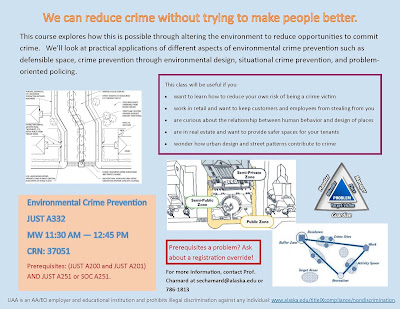
Environmental Crime Prevention (JUST A332) flyer
We can reduce crime without trying to make people better. The Spring 2019 course Environmental Crime Prevention (JUSTA332) explores how this is possible through altering the environment to reduce opportunities to commit crime. We’ll look at practical applications of different aspects of environmental crime prevention such as defensible space, crime prevention through environmental design, situational crime prevention, and problem-oriented policing.

This class will be useful if you

  • want to learn how to reduce your own risk of being a crime victim;
  • work in retail and want to keep customers and employees from stealing from you;
  • are curious about the relationship between human behavior and design of places;
  • are in real estate and want to provide safer spaces for your tenants;
  • wonder how urban design and street patterns contribute to crime.

This elective course will be held Mondays and Wednesdays, 11:30 to 12:45 PM.

  • CRN: 37051
  • Catalog description: Examines the theoretical background to opportunity— reducing in environmental crime prevention. Explores the application and implementation of crime prevention through environmental design, defensible space, and problem-oriented policing. Illustrates the practical and policy difficulties of environmental crime prevention through the use of case studies and field work.
  • Special note: JUST A320 recommended
  • Prerequisites: JUST A200 and JUST A201 and (JUST A251 or SOC A251).

Prerequisites a problem? Ask about a registration override!

For more information, contact Prof. Sharon Chamard at sechamard@alaska.edu or 786-1813.

Registration for Spring 2019 courses begins on November 12 for seniors, November 13 for juniors, and November 14 for sophomores.

Tuesday, November 6, 2018

Compensation for disabling injuries focus of course on Torts, Worker’s Compensation, & Insurance Law (LEGL/JUST A380)

Torts, Worker’s Compensation, & Insurance Law (LEGL/JUST A380) flyer
There are 26 million disabling injuries every year in the U.S.—and the economic cost of those injuries reach into the hundreds of billions. Why is the compensation system for such injuries so expensive, burdensome, inadequate, and slow? Does it work to deter unsafe conduct and products? Is it possible to be both fair and administratively efficient? Torts, Worker’s Compensation, & Insurance Law (LEGL/JUST A380) will examine these questions.

Studying tort law involves a lot more than learning doctrinal rules—it integrates a fundamental understanding of the American legal system. It’s also a great way to learn some professional skills in a true-to-life setting.

This Spring 2019 elective will be held Mondays and Wednesdays from 5:30 to 6:45 PM.
  • CRN: 37060
  • Catalog description: Analyzes nature and function of the law of torts, workers' compensation, and liability insurance in the United States, as well as the role of the nonlawyer legal professional in tort litigation and workers' compensation claims. Includes ethical issues in tort, workers' compensation, and insurance cases. Practice in Alaska and the development of professional skills are emphasized. Legal specialty course.
  • Registration Restrictions: Completion of LEGL A356 is strongly recommended.
  • Prerequisites: LEGL A101 with a minimum grade of C and LEGL A215 with a minimum grade of C.
If course prerequisites are a problem, ask about a registration override.

For more info, contact Prof. Kristin Knudsen at kknudsen@alaska.edu or 786-4885.

Registration for Spring 2019 courses begins on November 12.

Victimization (JUSTA490-002) examines how we might better respond to and enable justice for victims of crime

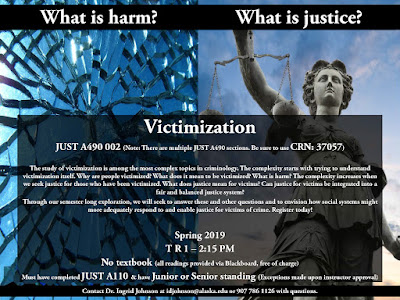
Victimization (JUSTA490-002) flyer
The study of victimization is among the most complex topics in criminology. The complexity starts with trying to understand victimization itself. Why are people victimized? What does it mean to be victimized? What is harm? The complexity increases when we seek justice for those who have been victimized. What does justice mean for victims? Can justice for victims be integrated into a fair and balanced justice system?

Through our semester-long exploration in Victimization (JUSTA490-002), we will seek to answer these and other questions and to envision how social systems might more adequately respond to and enable justice for victims of crime.

This Spring 2019 elective course will be held Tuesdays and Thursdays from 1:00 to 2:15 PM. There will be no textbook — all readings will be provided via Blackboard, free of charge.

  • CRN: 37057 (Note: There are multiple sections of JUST A490. Be sure to use the right CRN for this course!)
  • Catalog description: JUST A490 is a variable topics course which addresses current issues. Topics of national interest as well as those peculiar to Alaska will be included. 
  • Special Note: JUST A490 may be repeated once for credit with a change in subtitle. 
  • Prerequisites: JUST A11O with Junior or Senior standing (exceptions made upon instructor approval)

Contact Dr. Ingrid Johnson at idjohnson@alaska.edu or (907) 786-1126 with questions.

Registration for Spring 2019 courses begins on November 12 for seniors and November 13 for juniors.