Dear Justice Center blog readers,
After several years of our blog, the Justice Center will now be posting fresh news content exclusively on our website, uaa.alaska.edu/justice. We appreciate the opportunity we've had to share our updates with our blog readers, and we thank everyone who counts themselves a reader and supporter of our work.
You will still be able to explore older stories and news on our blog. But to keep up with our latest--from faculty research to notable students and alumni--head over to our website! You can also follow us on Facebook and Twitter.
Sincerely,
Henry Randolph
Editor
University of Alaska Justice Center

Wednesday, June 19, 2019
Friday, May 24, 2019
Dr. Troy Payne Examines Place Management in Neighborhood Context
 In apartment complexes, managers can attempt to reduce crime rates by changing how they train staff, screen tenants, and carry out other management practices. But how do broader neighborhood conditions influence the effectiveness of those practices?
 In a new article in Security Journal, Dr. Troy Payne and co-authors address this question by analyzing manager survey data from 238 apartments across 29 neighborhoods in Cincinnati.
“The study demonstrates that crime is impacted by many factors including both place-level and neighborhood-level effects that interact in complex ways,” said Dr. Payne. “Our findings suggest that crime mitigation measures by property owners in advantaged neighborhoods reduce crime. However, preventative building management practices in disadvantaged neighborhoods have lesser benefit.”
You can access the full article here.


Monday, May 20, 2019
Alumna April Stone: Up For Every Challenge
 We sat down to talk with alumna April Stone about what it’s
like to be a nontraditional student pursuing a law career. In 2017 April graduated
from the Justice Center’s accelerated justice major, which allowed her to enter
law school—something she always knew she wanted to do—after her third year as
an undergrad. In addition to being a parent, April worked as a paralegal before
and during her time at UAA. She is currently finishing her JD at the University
of Oregon School of Law.
We sat down to talk with alumna April Stone about what it’s
like to be a nontraditional student pursuing a law career. In 2017 April graduated
from the Justice Center’s accelerated justice major, which allowed her to enter
law school—something she always knew she wanted to do—after her third year as
an undergrad. In addition to being a parent, April worked as a paralegal before
and during her time at UAA. She is currently finishing her JD at the University
of Oregon School of Law.
How would you describe your experience as a nontraditional student at
the Justice Center?
It was nothing like I thought it would be. I was expecting
to be the old person in college when I started at 27 years old. I realized very
quickly that many students at UAA were both older than me and younger than me,
and I was relieved that there was so much age diversity.
I also didn’t want my undergraduate program to be so time
consuming that it took away from my ability to be a parent. Balancing full-time
work, school and parenting required a lot of organization—I needed to block
time out to do homework, and also to be a parent. But I found that with careful
planning it was totally manageable.
I also found that online classes worked really well for me,
because I wanted to be at home more and minimize the amount of time I had to
take off work. I was surprised at how many classes I could take without going
to campus.
What do you like about law as a career?
I like the challenge! There’s so much strategy involved, and
that makes it intellectually stimulating. I also like the ability to help
someone in a way that they can’t help themselves. People depend on lawyers for
all kinds of things—sometimes in critical situations, sometimes to plan for the
future, or sometimes just to handle a problem that’s been nagging at them. But
each of those things involves a lawyer offering something that people couldn’t
do on their own. I like the responsibility that comes with that. No matter what
type of work I’m doing, it really benefits someone.
What advice would you give students who want to go to law school?
Becoming a lawyer is a lot of work. You can expect your class
workload to double or triple in the first year of law school, so make sure you’re
fully invested and put in everything you’ve got. But I’d also say: Don’t
underestimate yourself. Don’t assume that you’re not capable of the work, and
don’t self-select out of opportunities by saying “I’m not good enough so I’m
not even going to try.” Because that’s how you miss out on the best
opportunities.
Any words of wisdom for nontraditional students?
I would definitely recommend that every student—nontraditional
or not—take advantage of UAA’s tuition waiver opportunities. Those helped me through
a lot of semesters, and some years they covered up to half of my tuition.
For working students: Ask questions. As a working parent, I
approached my boss and said, “I want to go to college if you’re supportive of
it.” I was able to work a crazy schedule so that I could leave for a few hours
in the middle of the day to go to class. Reach out to everyone—your family and
friends, your childcare provider, your boss, your school. There’s more support
and resources for non-traditional students than I ever expected.
Also, talk to your professors! I got some great advice from
the faculty in the Justice Center by just knocking on doors and saying, “Here’s
what I want to do—help me get there.” Students don’t always take advantage of
the wealth of knowledge in the Justice Center, and the resources there that
help you reach your goals beyond college. I’m grateful to the faculty who helped
me put this career plan together.
Friday, April 19, 2019
Dr. Johnson seeks study participants for study to improve sexual assault reporting system: Media reports

"What we know is that there's improvements that can be made to the reporting process more generally," Dr. Johnson told KTVA, "so to not only encourage people to report in the first place, but also to make sure those who do report have a positive experience."
Dr. Johnson will personally interview participants from throughout the state who are willing to talk about their experiences. Study participants will remain anonymous and will be paid for their time. Study participants must have been at least 18 years old at the time of the assault. Both women and men are encouraged to participate.
The interview process includes questions about the sexual assault reporting experience, as well as the participant’s perspectives on justice and how improvements could be made to the reporting system.
For further information, contact Dr. Ingrid Johnson at idjohnson@alaska.edu or 907-786-1126, or see the Alaska SAKI study Facebook page.
Media reports
- "UAA Seeks Sexual Assault Victims for New Study." KTVA Channel 11 News, 17 Apr 2019.
- "Sexual Assault Victim-Survivors Have Opportunity to Shape Better Response System through UAA Justice Center Project." Anchorage Press, 17 Apr 2019.

Thursday, March 7, 2019
AJiC releases Fact Sheet on property crime, with particular focus on motor vehicle theft

The fact sheet is by Yevgenii Kisarauskas, Research Professional, Alaska Justice Information Center (AJiC). The AJiC Fact Sheet series addresses various crime and criminal justice topics.
Citation:
- Kisarauskas, Yevgenii. (2019). "Property Crime in Alaska, 1985–2017." AJiC Fact Sheet 19-01 (Mar 2019).
Thursday, December 20, 2018
AJiC Fact Sheets present 1986–2017 data on drug arrests in Alaska by type of drug and sex of arrestee
The 18-06 and 18-07 (December 2018) issues of the AJiC Fact Sheet present data on drug sale and manufacture arrests and drug possession arrests in
Alaska for 1986 to 2017 by type of drug and sex of arrestee. Types of drugs include narcotics, synthetic narcotics, marijuana, and other non-narcotic
drugs. Data are drawn from the annual Crime in Alaska report of the Alaska Department of Public Safety, which represents the State of Alaska's
contribution to the FBI's Uniform Crime Reports (UCR) program.
This fact sheet presents data on drug sale and manufacture arrests by type of drug and sex of arrestee as reported by Alaska law enforcement agencies for the 32-year period 1986 to 2017. Types of drugs include narcotics, synthetic narcotics, marijuana, and other non-narcotic drugs. Overall, males comprise roughly three-fourths of the total drug sale and manufacture arrests in the state of Alaska. The female and male rates parallel one another in that they rise and fall at the same points in most years. For all drugs, the difference between female and male arrest rates in 2017 are smaller than in 1986.
Citation:
This fact sheet presents data on drug possession arrests by type of drug and sex of arrestee as reported by Alaska law enforcement agencies for the 32-year period 1986 to 2017. Types of drugs include narcotics, synthetic narcotics, marijuana, and other non-narcotic drugs. Overall, males comprise roughly four out of five drug possession arrests in the state of Alaska. The female and male rates parallel one another in that they rise and fall at the same points in most years.
Citation:
 Drug Sale and Manufacture Arrests Reported in Alaska, 1986–2017 — Drug Types by Sex
(AJiC Fact Sheet 18-06)
This fact sheet presents data on drug sale and manufacture arrests by type of drug and sex of arrestee as reported by Alaska law enforcement agencies for the 32-year period 1986 to 2017. Types of drugs include narcotics, synthetic narcotics, marijuana, and other non-narcotic drugs. Overall, males comprise roughly three-fourths of the total drug sale and manufacture arrests in the state of Alaska. The female and male rates parallel one another in that they rise and fall at the same points in most years. For all drugs, the difference between female and male arrest rates in 2017 are smaller than in 1986.Citation:
- Ervin, Benjamin. (2018). "Drug Sale and Manufacture Arrests Reported in Alaska, 1986–2017 — Drug Types by Sex." AJiC Fact Sheet 18-06 (Dec 2018).
 Drug Possession Arrests Reported in Alaska, 1986–2017 — Drug Types by Sex
(AJiC Fact Sheet 18-07)
This fact sheet presents data on drug possession arrests by type of drug and sex of arrestee as reported by Alaska law enforcement agencies for the 32-year period 1986 to 2017. Types of drugs include narcotics, synthetic narcotics, marijuana, and other non-narcotic drugs. Overall, males comprise roughly four out of five drug possession arrests in the state of Alaska. The female and male rates parallel one another in that they rise and fall at the same points in most years.Citation:
- Ervin, Benjamin. (2018). "Drug Possession Arrests Reported in Alaska, 1986–2017 — Drug Types by Sex." AJiC Fact Sheet 18-07 (Dec 2018).
The fact sheets are by Benjamin Ervin, Research Professional, Alaska Justice Information Center (AJiC). The AJiC Fact Sheet series addresses various crime and criminal justice topics.
Tuesday, November 27, 2018
Justice Center seeks a Communications Coodinator & Editor

This position provides editorial assistance with the preparation of Alaska Justice Forum articles, research reports, scholarly papers and presentations, and research proposals. The position orchestrates and supervises the entire publication process for the Alaska Justice Forum, including developing publication content with a focus on integration and synthesis of research findings on justice topics/issues. The successful candidate will serve as the Justice Center's media liaison and will also coordinate and supervise Justice Center public activities and events.
Requirements:
- Knowledge of communications theory and application in research, execution and evaluation of communications functions, best practices, and industry standards.
- Ability to mutli-task in a timely manner.
- Knowledge of cross-cultural communications, including translation of technical documents into forms accessible to general audiences.
- Ability to design print, multimedia, Web and collateral material.
- Ability to work and solve problems independently.
For more information contact the UAA Justice Center at (907) 786-1810.
Tuesday, November 20, 2018
Dr. Myrstol & Dr. Johnson on Hometown Alaska discuss sexual assault research
 |
| On Alaska Public Media's "Hometown Alaska — Justice Alaska," 19 Nov 2018: (front, left to right) Judge Elaine Andrews (ret), host; Dr. Ingrid Johnson, UAA Justice Center; Dr. Brad Myrstol, Director, UAA Justice Center; (back) host Kathleen McCoy, Alaska Public Media. Photo by Shelly Wozniak, UAA College of Health |
The program focused on UAA Justice Center's research mission, with a particular emphasis on research being undertaken by Dr. Johnson to support the Alaska Department of Public Safety's sexual assault kit initiative (SAKI), which is focused on improving the Alaska State Troopers' and partner agencies' responses to sexual assault.
Learn more about the Alaska Sexual Assault Kit Initiative (AK-SAKI):
- "Sexual Assault Kit Initiative: Alaska Making Progress" by Pamela Cravez. Alaska Justice Forum 34(4) (Spring 2018).
Additional resources are available on the Alaska Public Media website, where the full program can also be heard:
- "UAA Justice Center Works for Data-Driven Public Policy on Sexual Assault Investigations" hosted by Kathleen McCoy and Elaine Andrews. Alaska Public Media, 19 Nov 2018.
Tuesday, November 13, 2018
Legal Studies program seeking an Assistant Professor of Justice

This tenure-track position is responsible for teaching and providing professional service to the University, to the profession/discipline, and to the community. Incumbent is expected to teach undergraduate legal studies courses on a variety of substantive and skills-based topics in legal studies and to serve as liaison with the Alaska legal community, developing career, service, and internship opportunities for students. The standard instructional workload is 4 courses per semester.
Requirements:
- Juris Doctor degree from a law school approved by the American Bar Association.
- Member in good standing of the Alaska Bar Association or the bar association of another state.
- Experience practicing criminal law is preferred, but not required.
- Seeking applicants that reflect the increasing diversity present in our community student body.
For more information contact the UAA Justice Center at (907) 786-1810.
Wednesday, November 7, 2018
Homelessness and Crime (JUSTA490-001) examines social problems associated with homelessness, including crime and victimization

These question will be examined in Homelessness and Crime (JUSTA490-001). This Spring 2019 elective course will be held Mondays and Wednesdays from 10:00 to 11:15 AM.
- CRN: 37056 (Note: There are multiple sections of JUST A490. Be sure to use the right CRN for this course!)
- Catalog description: JUST A490 is a variable topics course which addresses current issues. Topics of national interest as well as those peculiar to Alaska will be included.
- Special note: JUST A490 may be repeated once for credit with a change in subtitle.
- Prerequisites: JUST A11O with Junior or Senior standing (exceptions made upon instructor approval). Ask about an override if you have a Social Science GER other than JUST A110.
For more information, contact Prof. Sharon Chamard at sechamard@alaska.edu or 786-1813.
Registration for Spring 2019 courses begins on November 12 for seniors and November 13 for juniors.
Environmental Crime Prevention (JUST A332) explores how to reduce crime by altering the environment
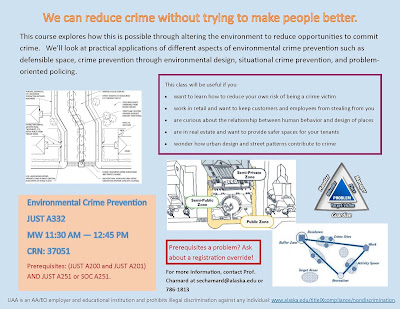
This class will be useful if you
- want to learn how to reduce your own risk of being a crime victim;
- work in retail and want to keep customers and employees from stealing from you;
- are curious about the relationship between human behavior and design of places;
- are in real estate and want to provide safer spaces for your tenants;
- wonder how urban design and street patterns contribute to crime.
This elective course will be held Mondays and Wednesdays, 11:30 to 12:45 PM.
- CRN: 37051
- Catalog description: Examines the theoretical background to opportunity— reducing in environmental crime prevention. Explores the application and implementation of crime prevention through environmental design, defensible space, and problem-oriented policing. Illustrates the practical and policy difficulties of environmental crime prevention through the use of case studies and field work.
- Special note: JUST A320 recommended
- Prerequisites: JUST A200 and JUST A201 and (JUST A251 or SOC A251).
Prerequisites a problem? Ask about a registration override!
For more information, contact Prof. Sharon Chamard at sechamard@alaska.edu or 786-1813.
Registration for Spring 2019 courses begins on November 12 for seniors, November 13 for juniors, and November 14 for sophomores.
Tuesday, November 6, 2018
Compensation for disabling injuries focus of course on Torts, Worker’s Compensation, & Insurance Law (LEGL/JUST A380)

Studying tort law involves a lot more than learning doctrinal rules—it integrates a fundamental understanding of the American legal system. It’s also a great way to learn some professional skills in a true-to-life setting.
This Spring 2019 elective will be held Mondays and Wednesdays from 5:30 to 6:45 PM.
- CRN: 37060
- Catalog description: Analyzes nature and function of the law of torts, workers' compensation, and liability insurance in the United States, as well as the role of the nonlawyer legal professional in tort litigation and workers' compensation claims. Includes ethical issues in tort, workers' compensation, and insurance cases. Practice in Alaska and the development of professional skills are emphasized. Legal specialty course.
- Registration Restrictions: Completion of LEGL A356 is strongly recommended.
- Prerequisites: LEGL A101 with a minimum grade of C and LEGL A215 with a minimum grade of C.
For more info, contact Prof. Kristin Knudsen at kknudsen@alaska.edu or 786-4885.
Registration for Spring 2019 courses begins on November 12.
Victimization (JUSTA490-002) examines how we might better respond to and enable justice for victims of crime
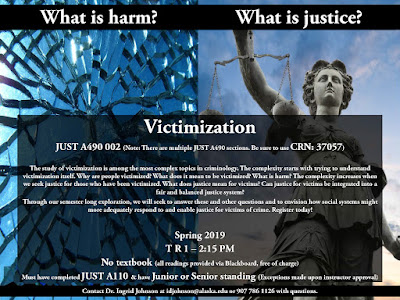
Through our semester-long exploration in Victimization (JUSTA490-002), we will seek to answer these and other questions and to envision how social systems might more adequately respond to and enable justice for victims of crime.
This Spring 2019 elective course will be held Tuesdays and Thursdays from 1:00 to 2:15 PM. There will be no textbook — all readings will be provided via Blackboard, free of charge.
- CRN: 37057 (Note: There are multiple sections of JUST A490. Be sure to use the right CRN for this course!)
- Catalog description: JUST A490 is a variable topics course which addresses current issues. Topics of national interest as well as those peculiar to Alaska will be included.
- Special Note: JUST A490 may be repeated once for credit with a change in subtitle.
- Prerequisites: JUST A11O with Junior or Senior standing (exceptions made upon instructor approval)
Contact Dr. Ingrid Johnson at idjohnson@alaska.edu or (907) 786-1126 with questions.
Registration for Spring 2019 courses begins on November 12 for seniors and November 13 for juniors.
Course on Probation, Parole and Community Corrections (JUST A445) explores supervision of offenders in the community

Probation, Parole and Community Corrections (JUST A445) will examine how the system of probation and parole developed, practices and methods of supervision of probationers and parolees, and programs for the reentry and reintegration of offenders into the community.
This Spring 2019 elective will be held Mondays and Wednesdays from 1:00 to 2:15 PM.
- CRN: 31502
- Catalog description: Covers the history and development of probation and parole, including notions of rehabilitation, reentry and reintegration. Investigates evidence-based standards, and numerous and diverse types of supervision, treatment, control, restoration and supportive programs for criminal offenders within the community.
- Prerequisites: JUST 110 & Junior/Senior Standing
Registration for Spring 2019 courses begins on November 12 for seniors and November 13 for juniors.
Police–Community Relations (JUST A434) explores the relationships between police and the many “publics” they serve

In Police–Community Relations (JUST A434), we will explore the nature of the relationships that exist between police and the many “publics” they serve, the factors that influence and give shape to those relationships, and to evaluate the implications of police – community relations for policing a democratic society.
This Spring 2019 elective will be held Mondays and Wednesday from 2:30 to 3:45 PM.
- CRN: 37054
- Catalog description: Examines police-community relations in the United States. Explores common conceptions of the police role, from the perspective of both the public and the police themselves, and their impact on police-community relations. Particular emphasis is given to recent developments aimed at ameliorating strained relationships between the police and the various communities they serve.
- Registration Restrictions: Senior standing or instructor approval
- Prerequisites: JUST A110 and JUST A200 and JUST A201
Course prerequisites a problem? Ask about a registration override!
Interested students are encouraged to contact Dr. Brad Myrstol at bamyrstol@alaska.edu or 907.786.1837 with questions.
Registration for Spring 2019 courses begins on November 12 for seniors and November 13 for juniors.
Monday, November 5, 2018
Crime Analysis & Mapping (JUST A432) course gives practical training in common crime analysis tasks used in law enforcement

The course gives students practical training in ArcGIS for Desktop and Excel, two of the most commonly-used tools in the industry. Enrollment includes a one-year academic license for ArcGIS for installation on your computer.
This Spring 2019 elective course will be held Tuesdays 2:30 to 5:15 PM.
- CRN: 31500
- Catalog description: Introduces analytical concepts and computer applications used in the study of temporal and spatial crime data. Demonstrates how these techniques can be used by justice agencies with a special emphasis given to police departments.
- Registration restrictions: Completion of all GER Tier 1 (basic college-level skills) courses and • Junior or senior standing
- Prerequisites: JUST A200 with a minimum grade of C and JUST A201 with a minimum grade of C.
- Attributes: UAA Integrative Capstone GER.
Registration for Spring 2019 courses begins on November 12 for seniors and November 13 for juniors.
The Courts (JUST A374) course examines the impact of courts on law, society, and politics

Find out in the Spring 2019 course The Courts (JUST 374), to be held on Tuesdays and Thursdays from 11:30 AM to 12:45 PM.
This is a required course for the Legal Studies B.A., a selective course for the Justice B.A., and a selective course for the Paralegal AAS, PBCT.
- CRN: 31496
- Catalog description: Examines the basic components of the U.S. courts with particular emphasis on case processing through the court system and the roles of court actors. Covers the history as well as the current structure and function of the court system and assesses the gap between the ideals and the realities of court processes and practices.
- Registration restrictions: Junior or senior standing.
- Prerequisites: JUST A110 or LEGL A101.
Registration for Spring 2019 courses begins on November 12 for seniors and November 13 for juniors.
Friday, November 2, 2018
Interested in law school? Join us Tuesday, Nov. 6 over pizza to discuss law school admissions


Substance Abuse and Crime course (JUST A366) explores relationship between substance abuse and crime
 What’s the relation between substance use and crime? What is the underlying mechanism? How does society treat drug-involved offenders?
Find out in the Spring 2019 course Substance Abuse and Crime (JUST A366). This elective course will be held Tuesdays and Thursdays from 2:30 to 3:45 PM.
- CRN: 37053
- Catalog description: Introduces the psychopharmacology, physiological effects and schedule classification for substance of abuse. Reviews data estimating extent of use, abuse and related consequences. Provides a critical analysis of the connection between crime and substance use. Differentiates between policy responses to substance use and abuse including prevention, treatment, enforcement and harm reduction.
- Registration restrictions: Junior or senior standing.
- Prerequisite: JUST A110.
Registration for Spring 2019 courses begins on November 12 for seniors and November 13 for juniors.
Thursday, November 1, 2018
60 Years Later: The Alaska Constitution, History in Context — videos and symposium materials available online

The symposium was co-sponsored by the UAA Justice Center and the Alaska Law Review in cooperation with the Historians Committee of the Alaska Bar Association. The program was approved for 4.5 CLE credits (including 1.5 Ethics credits) by the Alaska Bar Association. Prof. Ryan Fortson, J.D., Ph.D., is the Justice Center faculty coordinator for this event.
The topic of this year's symposium was selected in anticipation of the sixtieth anniversary of Alaska statehood. The Constitution of the State of Alaska was adopted by the Alaska Constitutional Convention February 5, 1956; ratified by the people of Alaska April 24, 1956; and became operative with the formal proclamation of Alaska statehood on January 3, 1959.
 |
| Erwin Chemerinsky, Dean of Berkeley Law |
 The Alaska Law Review will be publishing an issue at a later date with articles prepared for the symposium. The Alaska Law Review is published by Duke University School of Law for the Alaska Bar Association. Meantime, symposium drafts of conference papers and videos of all sessions are available for download at the UAA Justice Center website.
 |
| Erwin Chereminksy, Dean, Berkeley Law delivers the keynote address at the Alaska Law Symposium "60 Years Later: The Alaska Constitution, History in Context," 12 Oct 2018. |
 |
| Panel on "A Comparative Persepctive of the Alaska Constitution." Left to right: moderator Tom Metzloff of Duke University and presenters G. Alan Tarr, Rutgers University and Center for State Constitution Studies, and Robert F. Williams, Rutgers School of Lawz |
 |
| Panel on "The Alaska Judicial Council and Merit Selection of Judges." Left to right: Judge Larry Card (ret.) and presenters Susie Mason Dosik, administrative attorney for the Alaska Judicial Council, and Brett Frazer of Latham & Watkins. |
 |
| Prof. Ryan Fortson, UAA Justice Center (right) introduces "A Native Perspective of Alaska's Constitution" panelists (seated left to right): Andy Erickson of Landye Bennett Blumstein LLP, John "Sky" Starkey of Landye Bennett Blumstein LLP, and Willie Hensley, University of Alaska Anchorage. |
 |
| Judge Sen K. Tan (ret.) and Alaska Constitutional Convention delegate Vic Fischer. |
Subscribe to:
Posts (Atom)