Lena's goal is to become an Alaska State Trooper. This year, she is one of 21 top students awarded the scholarship by LEEP's professional public safety officers. The LEEP scholarship is presented to students interested in pursuing a career in public safety and all of its related fields — law enforcement, police-fire dispatch, corrections officer, firefighting or emergency medical technicians (EMT).
The Law Enforcement Education Program (LEEP) is a non-profit organization dedicated to public safety research and education with a focus on child safety. LEEP was founded in 1997 and expanded nationally in 2004 to reach children and teens throughout the country.
Prof. Deb Periman, J.D., and Dr. Ron Everett, Justice faculty, were selected to participate in this week'siTeach at UAA. The program is a five-day intensive hands-on clinic for UAA instructors, offered by the Instructional Design Team at the UAA Faculty Technology Center.
The iTeach intensive assists faculty in:
L to r: Prof. Periman; Sarah Frick, FTC Instructional
Designer (standing); Dr. Everett (foreground) take
a break during the iTeach intensive.
designing courses that are fun, possess academic integrity and meet UAA's academic guidelines;
joining a community of like-minded iTeach participants who care about course quality;
gathering and managing their own research;
creating course schedules that work for them and their students;
building and manageing online learning communities; and
developing pedagogically sound face-to-face or online courses.
UAA is collaborating with UAF eLearning and Distance Education to adopt the iTeach training framework. Many instructors within the UA system have taken advantage of this exceptional professional development opportunity over the last several years.
L to r: Dr. Sharon Chamard, Dr. Troy Payne, and Barbara Armstrong
at the UAF Wood Center, site of the workshop.
Dr. Sharon Chamard and Dr. Troy Payne, Justice faculty, and Barbara Armstrong, Alaska Justice Forum editor, attended the National Science Foundation (NSF) workshop, "Science: Becoming the Messenger," held at the University of Alaska Fairbanks (UAF) on July 17.
The “Science: Becoming the Messenger” workshop, which is offered by NSF all over the nation, equips attendees with the skills and techniques communications professionals use to influence people’s thinking and attitudes, and demonstrates how these skills can be used to win support for research. The workshop was led by three experienced science communicators, and covered strategies from crafting a message to delivering it - using both traditional and new media.
Dr. Chamard on screen in the video shown at the workshop.
Part of this interactive program included filming a video of a "pitch" for funding for a project using some of the techniques that had been demonstrated earlier. Participants videoed each other using cell phones or other mobile devices.
Dr. Chamard's video was chosen by the workshop leader, Joe Schreiber, to use as an example of how to edit and use still photos with a video. Mr. Schreiber took the raw video, edited it, inserted appropriate stills related to the topic, then showed it to the group.
In the video, Dr. Chamard explains that her project would look at spatial predictors for where homeless encampments are located, and the environmental impact of those encampments, including the risk of accidental/intentional fires, habitat destruction, and health and sanitation issues. Using spatial predictors, public agencies and social service providers could more easily find homeless encampments. This would allow them to offer alternative housing arrangements to campers, and close the camps before they become so large and entrenched that they are environmental hazards.
Among other UAA community members who attended the program were Dr. Diane Hirshberg, Director, Center for Alaska Education Policy Research; Prof. Mara Kimmel, Dept. of Political Science & ISER; Dr. Bridget Hanson, Research Assistant Professor, Center for Behavioral Health Research and Services; and Dr. Jonathan Alevy, Economics Department.
Dr. Hirshberg was one of the attendees selected to present her proposed project to the entire workshop audience. The audience voted on whether projects should hypothetically be funded or not, and Dr. Hirshberg successfully convinced the group that her project - which focused on education in Alaska - should be awarded foundation support. Her next assignment was a mock interview with a real-life journalist during which she had to defend her project and the hypothetical funding award. Dr. Hirshberg persuasively answered all the challenges and questions put to her during the interview.
On stage: Dr. Hirshberg (r) is interviewed by Chris Mooney,
a Washington, D.C. journalist.
Dr. Troy Payne, Justice faculty, published a review of a research paper, "Risky Facilities: Crime Concentration in Homogeneous Sets of Establishments and Facilities," by John E. Eck, University of Cincinnati; Ronald V. Clarke, Rutgers University, and Rob T. Guerette, Florida International University, in Crime Analyst’s Research Digest, 2nd edition.
This publication by the International Association of Crime Analystsfeatures summaries on general topics. Practitioners and researchers who are knowledgeable in the field provide crime analysts with a quick summary of relevant research articles.
The report presents data on the adult probation/parole population under Alaska
Department of Corrections supervision for the period 2002–2012, and
briefly describes how probation and parole operate in Alaska. Data were
extracted from the annual Offender Profile publication of the
Alaska Department of Corrections. The report examines the total numbers
of adults under probation/parole supervision, rates of supervision,
demographic breakdowns by sex and race, and distribution by supervising
authority. The Fact Sheet is authored by Dr. Brad A. Myrstol, director of the Alaska Justice Statistical Analysis Center (AJSAC).
The AJSAC is housed within the UAA Justice Center, and published the monthly AJSAC Fact Sheet addressing various crime and criminal justice topics.
Dr. Allan Barnes and Dr. Marny Rivera, Justice faculty, are serving on the College of Health (COH) Academic Assessment Task Force formed by Dean Bill Hogan.
The purpose of the task force is to evaluate the general state of academic assessment in the College of Health, and provide feedback and recommendations to the Dean. The task force will review plans and surveys, meet with selected programs, and prepare a report for the dean. The main work of the task force will be completed by August 9 with a report to follow. Dr. Barnes is the task force coordinator.
Task force members are:
Prof. Stephanie Olson – Dental Hygiene
Prof. Catherine Sullivan – Nursing
Dr. Marny Rivera – Justice
Dr. Beth Sirles – Social Work
Dr. Allan Barnes - Justice - Task Force Coordinator
Photo of Della Puyuk Keats, Inupaiq doctor
(1909 - 1986)
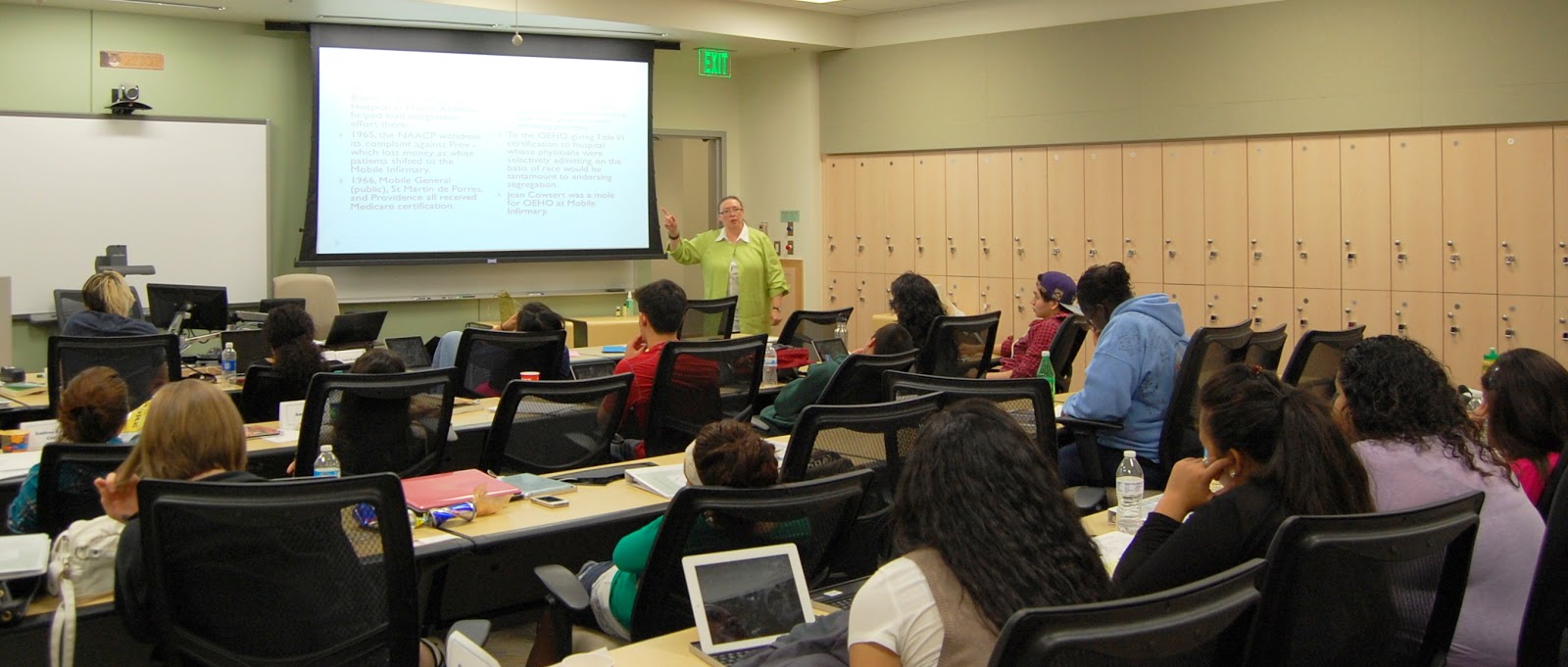
Prof. Kristin Knudsen, J.D., presented “Law and Medicine: How Law Shapes Our Health Care System (or Not)" to students in the Summer 2013 Della Keats Health Sciences Summer Program at UAA on July 23.
Prof. Knudsen's presentation focused on historical events in health care delivery in
the U.S. and Alaska, and the intended and unintended impact of three
laws responding to those events: the Hill-Burton Act of 1946, Title XVIII of the Social Security Act (Medicare - 1965), and the Alaska Turning Point Act of 2005.
The residential summer program is named after Della Keats, an Inupiq doctor, and seeks to foster, affirm, and
encourage high school students’ interest in the medical professions. The WWAMI School of Medical Education sponsors this UAA program for high school students who come from an ethnic minority background,
live in rural Alaska off the road system, are first-generation American,
speak English as a second language, and/or are economically
disadvantaged.
Standing center: Prof. Knudsen discusses the impact of law on health care in Alaska.
The Della Keats Leadership Team members are Dr. Ian van Tets and Dr. René Contreras, Co-Directors; Cassandra Dale, Program Coordinator; and Dr. E.J. David, ANCAP Director.
Prof. Brandeis teaches courses on American government,
constitutional law and civil liberties, and is a frequent speaker on
constitutional law and other legal issues. Prof. Brandeis also maintains
a private law practice through which, subsequent to the date of this Anchorage Daily News article, he provided legal representation in administrative agency
proceedings for the Campaign to Regulate Marijuana Like Alcohol in
Alaska.
Her report presents information on reported participation, role perception, attitudes toward law, recruitment and satisfaction with experience among lay members of mixed administrative tribunals based on a survey of lay members of Alaska’s adjudicatory boards and commissions.
A “mixed” administrative tribunal is an appointed board or commission
that decides legal issues with the involvement of a professional
administrative law judge; this involvement varies in degree and
methods, depending on the tribunal’s rules and statutes.
Dr. Marny Rivera and Dr. Cory R. Lepage, Justice faculty, have been asked to serve as members of the Domestic Violence and Sexual Assault (DVSA) Data Group. Katie TePas, Office of the Governor, is the data group chair.