 The New York Times highlighted low recidivism rates among sex offenders in a recent Op-Docs commentary, including an Alaska rate of 3.4% from a 2001 study. A more comprehensive analysis of Alaska's sex offender recidivism rates can be found in a report co-authored by Dr. Brad Myrstol, interim Justice Center director and director of the Alaska Justice Statistical Analysis Center (AJSAC) and Alaska Justice Information Center. The Alaska Sex Offender Recidivism and Case Processing Study confirms that Alaska sex offenders are infrequently rearrested or reconvicted for the new commission of new sex offenses.

Showing posts with label Alaska Justice Statistical Analysis Center (AJSAC). Show all posts
Showing posts with label Alaska Justice Statistical Analysis Center (AJSAC). Show all posts
Friday, September 15, 2017
Sex offender low recidivism in NYT and AJSAC research
The New York Times highlighted low recidivism rates among sex offenders in a recent Op-Docs commentary, including an Alaska rate of 3.4% from a 2001 study. A more comprehensive analysis of Alaska's sex offender recidivism rates can be found in a report co-authored by Dr. Brad Myrstol, interim Justice Center director and director of the Alaska Justice Statistical Analysis Center (AJSAC) and Alaska Justice Information Center. The Alaska Sex Offender Recidivism and Case Processing Study confirms that Alaska sex offenders are infrequently rearrested or reconvicted for the new commission of new sex offenses.


Friday, July 14, 2017
Rosay appointed associate dean in College of Health, Myrstol interim Justice Center director
 |
| Dr. Andre Rosay, newly appointed associate dean for academic and student affairs in the College of Health |
 |
| Dr. Brad Myrstol appointed interim Justice Center director |
Dr. Brad Myrstol, director of the Alaska Justice Statistical Analysis Center and the Alaska Justice Information Center, has been appointed interim director of the Justice Center.
Dr. Myrstol received his Ph.D in Criminal Justice from Indiana University in 2006. He has served as the principal or co-principal investigator on a variety of Alaska justice topics including the offending trajectories of juveniles, the criminal case processing of domestic violence, sexual assault and sexual abuse of a minor cases, the role and impact of Alaska’s Village Public Safety Officer (VPSO) program on the state’s response to domestic violence and sexual assault, sex offender recidivism trajectories, sexual violence victimization among university students, the structure and organization of policing in Alaska, as well as factors impacting charging, time-to-disposition, and sentencing outcomes in felony cases.
While at UAA, Dr. Myrstol has received over $1 million in research funding from sources including the U.S. Department of Justice, Bureau of Justice Statistics, U.S. Department of Justice, National Institute of Justice, as well as Alaska state and local agencies.
A nationwide search for a new director will be launched in the future.
Monday, February 20, 2017
AJSAC Fact Sheet: Violent Crime Reported in Alaska, 1986–2015

From 1986 to 2015, violent crime rates increased in Alaska although the overall crime rate decreased. Homicide and robbery rates declined over the 30-year period, while rape and aggravated assault rates increased from 1986 to 2015 – with aggravated assault acting as the main driver of increases in the violent crime rate over the period. On average, violent crime accounted for 11 percent of all crime reported in Alaska from 1986 to 2015. Aggravated assault accounted for nearly three-quarters, robbery for nearly 15 percent, rape for nearly 13 percent, and homicide for just over one percent of all violent crime reported in Alaska over the period.
The fact sheet is by Khristy Parker, Research Professional, Alaska Justice Statistical Analysis Center (AJSAC). The AJSAC Fact Sheet series addresses various crime and criminal justice topics.
Citation:
- Parker, Khristy. (2017). "Violent Crime Reported in Alaska, 1986–2015." AJSAC Fact Sheet 17-02 (Feb 2017).
Media coverage:
- "Violent Crime up in Alaska over Past 30 Years, Even as Overall Crime Rate Fell" by Michelle Theriault Boots. Alaska Dispatch News, 20 Feb 2017.
- "Data Viz: Statewide Crime Reported in Alaska (1960-2015)" by Sidney Sullivan. KTUU Channel 2 News, 20 Feb 2017.
Monday, February 6, 2017
AJSAC Fact Sheet: "Property Crime Reported in Alaska, 1986–2015"

The fact sheet is by Khristy Parker, Research Professional, Alaska Justice Statistical Analysis Center (AJSAC). The AJSAC Fact Sheet series addresses various crime and criminal justice topics.
Citation:
- Parker, Khristy. (2017). "Property Crime Reported in Alaska, 1986–2015." AJSAC Fact Sheet 17-01 (Jan 2017).
Media coverage:
- "Study: Anchorage Property Crimes Decreased over 30-Year Period" by Jerzy Shedlock. Alaska Dispatch News, 6 Feb 2017.
Tuesday, January 10, 2017
Dr. Payne interviewed by Alaska Public Media about homicides in Anchorage
 December 29, 2016 — A Fact Sheet published by the Alaska Justice Statistical Analysis Center in November 2016 showed a steady decline in Anchorage’s homicide rate from 1986 to 2015. During this period, Anchorage had an average of 17 homicides per year. In 2016, the number of homicides in Anchorage increased to 34. Throughout 2016, as noted by Zachariah Hughes with Alaska Public Media, “news reports from Anchorage have been particularly morbid, with frequent stories about shootings and homicides.”
While the increase in the number of homicides is striking, Dr. Troy Payne, a faculty member of the UAA Justice Center, explained how this could just be a random fluctuation from year to year. At this point, it is difficult to know if there is a systemic repeatable problem that we can apply solutions to. As Dr. Payne explained, additional information will be needed to determine if this is an emerging trend and to understand the causes of these homicides.
Links:
- "34 Homicides and No Clear Solution in Anchorage" by Zachariah Hughes. Alaska Public Media, 29 Dec 2016
- "Homicide in Alaska, 1986–2015" by Khristy Parker. AJSAC Fact Sheet 16-06 (Nov 2016).
Monday, November 7, 2016
Khristy Parker interviewed by KTUU Channel 2 News about recent AJSAC Fact Sheet on homicide in Alaska

 The Fact Sheet presents data from the Alaska Department of Public Safety’s annual report Crime in Alaska. Overall, homicide rates have declined steadily during the 30-year period 1986-2015 in Alaska. The Fact Sheet also presents data on homicide weapons used, victim-offender relationships, and clearance rates for homicide crimes during this time period.
Story: "Homicides in Alaska" by Kyle Hopkins. KTUU Channel 2 News, 1 Nov 2016.
Tuesday, November 1, 2016
AJSAC Fact Sheet released - Homicide in Alaska, 1986-2015
 The most recent issue of the AJSAC Fact Sheet, "Homicide in Alaska, 1986-2015," presents data on homicide rates in Alaska over a 30-year period. Homicides rates were calculated for Alaska (AK), the Municipality of Anchorage (MOA) only, and Alaska - excluding the Municipality of Anchorage (AK-MOA). Data show that homicide rates have declined steadily over the 30-year period.
The Fact Sheet also presents data on the most commonly used weapons in homicides, victim-offender relationships, and clearance rates for homicides.
The fact sheet is by Khristy Parker, Research Professional, Alaska Justice Statistical Analysis Center (AJSAC).
Citation:
- Parker, Khristy. (2016). "Homicide in Alaska, 1986–2015." AJSAC Fact Sheet 16-06 (Nov 2016).
Media coverage:
- "Homicides in Alaska" by Kyle Hopkins. KTUU Channel 2 News, 1 Nov 2016.
- "34 Homicides and No Clear Solution in Anchorage" by Zachariah Hughes. Alaska Public Media, 29 Dec 2016.
- "Death Count Rising" by Craig Medred. craigmedred.news, 3 Feb 2017.
Wednesday, October 12, 2016
AJSAC releases Fact Sheet - Sexual Violence Committed Against University of Alaska Students, by Gender

The results presented here are based on the survey responses of a randomly selected sample of 1,982 undergraduate and graduate students who were enrolled at any of the three UA major administrative units (MAUs) — UA Anchorage (UAA), UA Fairbanks (UAF), or UA Southeast (UAS) during spring semester 2016. This survey was modeled after the Campus Climate Survey Recommendations prepared by the White House Task Force to Protect Students from Sexual Assault.
Dr. Lindsey Blumenstein, Justice Center faculty, and Dr. Brad Myrstol, Director, Alaska Justice Statistical Analysis Center (AJSAC), are the authors of this Fact Sheet.
Monday, September 26, 2016
New webpage look and new web addresses for the Justice Center, Alaska Justice Statistical Analysis Center, and Alaska Justice Information Center

The Justice Center, the Alaska Justice Statistical Analysis Center (AJSAC), and the Alaska Justice Information Center (AJIC), have new web addresses and a new look to their web pages as part of the new UAA website redesign.
Click below and see our new web pages!

Justice Center - www.uaa.alaska.edu/justice

Alaska Justice Statistical Analysis Center - www.uaa.alaska.edu/ajsac

Alaska Justice Information Center - www.uaa.alaska.edu/ajic
Tuesday, September 6, 2016
AJSAC Fact Sheet reports referenced in KTUU Channel 2 News story about crime in Anchorage
 Alaska Justice Statistical Analysis Center (AJSAC) Fact Sheets on violent crimes and drug arrests in Alaska were referenced in a recent KTUU Channel 2 news story about crime in Anchorage.
 Dr. Brad Myrstol, Justice Center faculty, is the director of the AJSAC. Khristy Parker, M.A., Research Professional, is the author of the Fact Sheets.
"Is crime on the rise in Anchorage? A look at the numbers," by Rebecca Palsha. KTUU Channel 2 News. 1 Sep 2016.

Wednesday, August 3, 2016
AJSAC Fact Sheets included in recent SAC Publication Digest
 The Justice Research and Statistics Association (JRSA) has released the online Jan - June 2016 SAC Publication Digest. The digest contains abstracts of reports from the nationwide statistical analysis center (SACs).
The volume includes three abstracts for Alaska Justice Statistical Analysis Center (AJSAC) Fact Sheets:
 "Alaska Trauma Registry: Trauma Admissions Involving Alcohol or Illegal Drugs, 2014"
Alaska Justice Statistical Analysis Center Fact Sheet 16-01
Author: Khristy Parker, MPA, Research Professional
"Juvenile Justice Referrals and Charges in Alaska, FY 2006–2015"
Alaska Justice Statistical Analysis Center Fact Sheet 16-02
Author: Khristy Parker, MPA, Research Professional
"Alaska Trauma Registry: Trauma Admissions Involving Firearms, 2009–2014"
Alaska Justice Statistical Analysis Center Fact Sheet 16-03
Author: Khristy Parker, MPA, Research Professional
The Justice Research and Statistics Association (JRSA) is a national nonprofit organization dedicated to the use of nonpartisan research and analysis to inform criminal and juvenile justice decision making. JRSA comprises a network of researchers and practitioners throughout government, academia, and the justice community.
Monday, June 6, 2016
AJSAC Fact Sheet released - Sexual misconduct and sexual assault committed against University of Alaska students

The University of Alaska Campus Climate Survey was designed to establish baseline estimates of sexual misconduct and sexual assault committed in the preceding year — both on and off campus — against students enrolled at UA during the spring semester 2016. This survey was modeled after the Campus Climate Survey Recommendations prepared by the White House Task Force to Protect Students from Sexual Assault. These data can be utilized by the University of Alaska to impact and evaluate prevention efforts and education programs for UA students.
Wednesday, April 20, 2016
AJSAC Fact Sheet released -- Alaska Trauma Registry: Trauma Admissions Involving Firearms, 2009-2014
 The most recent issue of the AJSAC Fact Sheet presents data on trauma admissions to all 24 Alaska acute care facilities for injuries involving firearms for the period 2009 - 2014. The report, "Alaska Trauma Registry: Trauma Admissions Involving Firearms, 2009–2014," presents data provided by the Alaska Department of Health and Social Services (DHSS), Department of Public Health, Alaska Trauma Registry.
The fact sheet is by Khristy Parker, Research Professional, Alaska Justice Statistical Analysis Center (AJSAC).
Friday, April 8, 2016
Dr. Myrstol interviewed by Mat-Su Valley Frontiersman about recent AJSAC report and sexual assault case delays

Dr. Myrstol's work described in the report is a collaborative effort with the Alaska Department of Public Safety, Alaska State Troopers, and the Alaska Department of Law, to empirically document the criminal justice case processing and outcomes of sexual assault, sexual abuse of a minor, and domestic violence cases in the state of Alaska.
He was interviewed in relation to a decades-long rape case that is the subject of the article. Dr. Myrstol noted, "What we’re attempting to do is build resource capacity and data resources … and make that available to the public and available for researchers to mine and explore." The study's primary objective is to understand the factors that influence domestic violence and sexual assault case attrition throughout the criminal justice process in order to improve case outcomes for victims, their families, and their communities.
Read the article here:
"Decades-long rape case sheds light on reality of Alaska crime" by Caitlin Skvorc. Mat-Su Frontiersman, 29 Feb 2016.

Monday, February 29, 2016
AJSAC releases report on domestic violence and sexual assault/sexual abuse of minor cases
The Alaska Justice and Statistical Analysis Center (AJSAC) recently released a final report, Descriptive Analysis of Domestic Violence and Sexual Assault Incidents Closed by the Alaska State Troopers: 2008-2011. This report is part of the Alaska Domestic Violence and Sexual Assault Case Processing Project.The results of the project have potential implications in a number of arenas including resource allocation, training for criminal justice professionals, as well as prevention efforts. The report was authored by Brad Myrstol, Ph.D., AJSAC Director, and Khristy Parker, M.P.A., AJSAC Research Professional.
The project is a collaborative effort with the Alaska Department of Public Safety, Alaska State Troopers, and the Alaska Department of Law, and is supported by a research grant award from the U.S. Department of Justice, Bureau of Justice Statistics.
The primary objective of the project is to empirically document the criminal justice case processing and outcomes of sexual assault, sexual abuse of a minor, and domestic violence cases in the state of Alaska. In coming years, the AJSAC intends to expand the project to include additional Alaska police agencies.
Click here to read the press release from the Alaska State Troopers Public Information Office.
Tuesday, February 2, 2016
AJSAC Fact Sheet highlighted on Justice Research and Statistics Association website

The fact sheet presents data from the Alaska Trauma Registry (ATR) on numbers of trauma admissions, patient demographics, and the presence of alcohol or illegal drugs in trauma admissions in 2014. Khristy Parker, Research Professional, is the author of the fact sheet.
JRSA also tweeted about the recent AJSAC Fact Sheet on Alaska Trauma Registry admissions.

 The Justice Research and Statistics Association is a national nonprofit organization of state Statistical Analysis Center (SAC) directors, and other researchers and practitioners throughout government, academia, and the justice community who are dedicated to the use of research and analysis to make informed policy and program decisions.
Monday, February 1, 2016
AJSAC Fact Sheet released: Juvenile Justice Referrals and Charges in Alaska, FY 2006–2015
 The most recent issue of the AJSAC Fact Sheet presents summary
information on referrals made by Alaska law enforcement agencies to the
Alaska Division of Juvenile Justice (DJJ) for for state fiscal years
2006–2015. The report, "Juvenile Justice Referrals and Charges in Alaska, FY 2006–2015," presents data on the number of referrals and charges made, and unique individuals referred to DJJ. Data is drawn from the DJJ Data Trends website.
The most recent issue of the AJSAC Fact Sheet presents summary
information on referrals made by Alaska law enforcement agencies to the
Alaska Division of Juvenile Justice (DJJ) for for state fiscal years
2006–2015. The report, "Juvenile Justice Referrals and Charges in Alaska, FY 2006–2015," presents data on the number of referrals and charges made, and unique individuals referred to DJJ. Data is drawn from the DJJ Data Trends website.The fact sheet is by Khristy Parker of the Alaska Justice Statistical Analysis Center (AJSAC).
Thursday, January 21, 2016
AJSAC Fact Sheet released - Alaska Trauma Registry: Trauma Admissions Involving Alcohol or Illegal Drugs, 2014

The fact sheet is by Khristy Parker of the Alaska Justice Statistical Analysis Center (AJSAC).
Thursday, November 5, 2015
Khristy Parker, AJSAC researcher, interviewed by Alaska Dispatch News about Fact Sheet on DOC post-conviction incarcerated population 2005-2014
 Khristy Parker, Alaska Justice Statistical Analysis Center (AJSAC) researcher, was interviewed by Jerzy Shedlock of the Alaska Dispatch News about the recent Fact Sheet on the Alaska Department of Corrections post-conviction incarcerated population 2005-2014.
Click here to read the article:
"Number of convict women in Alaska prisons up as overall population drops," by Jerzy Shedlock. Alaska Dispatch News. 02 Nov 2015.

Monday, November 2, 2015
AJSAC Fact Sheet: Alaska Department of Corrections: Post-Conviction Incarcerated Population, 2005–2014
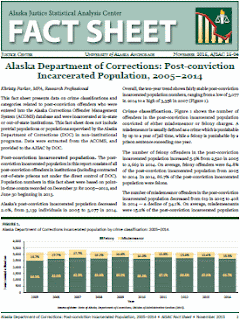
The fact sheet is by Khristy Parker of the Alaska Justice Statistical Analysis Center (AJSAC).
Subscribe to:
Posts (Atom)