Showing posts with label Barbara Armstrong. Show all posts

Friday, January 6, 2017

Summer/Fall 2016 issue of the Alaska Justice Forum

Alaska Justice Forum 33(2–3), Summer/Fall 2016
The Summer/Fall 2016 issue of the Alaska Justice Forum presents articles on the Recover Alaska initiative to address Alaska's alcohol-related problems; therapeutic courts in Alaska; findings of the Alaska Judicial Council's analysis of felony sentencing patterns in Alaska in 2012–2013; outcomes of the Teens Acting Against Violence (TAAV) program in Bethel seen through the lens of Search Institute's 40 Developmental Assets; and a farewell from Barbara Armstrong, whose eight-year tenure as editor of the Alaska Justice Forum is ending with this issue.

The 12-page issue includes the following articles:

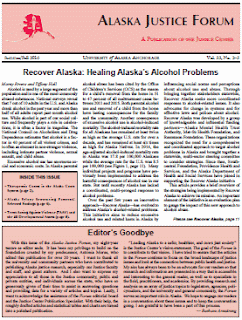
"Recover Alaska: Healing Alaska's Alcohol Problems" by Marny Rivera and Tiffany Hall

This article provides an overview of the strategies being implemented by the Recover Alaska initiative in its mission to reduce excessive alcohol use and related harm in Alaska by influencing social norms and perceptions about alcohol use and abuse. Includes a list of online resources.

"Editor's Goodbye" by Barbara Armstrong

Barbara Armstrong, editor of the Alaska Justice Forum since 2008, is leaving the Justice Center at the end of December 2016.

"Therapeutic Courts in the Alaska Court System" by Barbara Armstrong

Therapeutic courts — often called “problem-solving courts” or “wellness courts” — have been a growing component of the U.S. court system since the 1990s. This article provides an overview of the development of Alaska Court System therapeutic courts, and describes the 12 therapeutic courts currently operating in Alaska as well as proposed pilot project courts. Includes a bibliography.

"Alaska Felony Sentencing Patterns: Selected Findings" by Teresa White Carns

This article describes selected findings from the Alaska Judicial Council's recently released report Alaska Felony Sentencing Patterns: 2012–2013. The report examines factors associated with felony sentences under new presumptive ranges set by the Alaska Legislature in 2005 and 2006. The study has been used by the Alaska Criminal Justice Commission (ACJC), established by the legislature in 2014 to make recommendations about criminal justice reform and sentencing.

"Teens Acting against Violence (TAAV) and the 40 Developmental Assets" by Khristy Parker

Teens Acting Against Violence (TAAV) is a student-led anti-violence education group formed in 1996 by Tundra Women’s Coalition (TWC) in Bethel, Alaska. This article looks at the program in light of the 40 developmental assets defined by the Search Institute, a nonprofit research program whose framework of strengths and supports for youth development has become an international benchmark. While the developmental assets were not intentionally incorporated in the design of the TAAV program, they are reflected in the program's outcomes.

"New Staff"

Jo Walker has joined the staff of the Justice Center as Academic Program Specialist, and Tristian Monterastelli, has joined the Alaska Justice Information Center (AJiC) staff as a Research Professional.

Friday, December 23, 2016

Summer/Fall 2016 issue of the Alaska Justice Forum released

The Summer/Fall 2016 issue of the Alaska Justice Forum has been released and contains the articles noted below.

Click here to read the PDF of this issue.

Articles:
"Recover Alaska: Healing Alaska's Alcohol Problems" by Marny Rivera and Tiffany Hall
"Therapeutic Courts in the Alaska Court System" by Barbara Armstrong
"Alaska Felony Sentencing Patterns: Selected Findings" by Teresa White Carns
"Teens Acting Against Violence and the 40 Developmental Assets" by Khristy Parker

Monday, October 17, 2016

Research position opening at Justice Center

Alaska Justice Forum editor, Barbara Armstrong, will be leaving the Justice Center at the end of this year.  The Justice Center is seeking a qualified individual to join our staff to supervise the publication process for the Forum, as well as other public dissemination activities, and to engage in independent research.

Read the position announcement here.

Please view the job posting for details.
http://careers.alaska.edu/cw/en-us/job/504947/research-professional-4

Tuesday, October 11, 2016

Barbara Armstrong, Forum editor, selected to receive 2016 Chancellor's Award for Staff Excellence

L to r: Barbara Armstrong and
Chancellor Tom Case at the
awards reception.
Barbara Armstrong, Alaska Justice Forum editor and Justice Center research professional, was recently announced as a recipient of the 2016 Chancellor's Award for Staff Excellence in recognition of her outstanding contributions and exceptional service to the university.

The Staff Excellence Award is given for demonstrated, well- recognized, sustained, or recent special effort by a staff person resulting in a significant and positive impact on UAA.

The Chancellor's Awards promote excellence and recognize individuals and groups for their exceptional service to the university community. The other categories for the Chancellor's Awards for Excellence include Teaching, Academic Research, Promoting Student Achievement,  Diversity, Community Engagement, and Stewardship. A reception for all the Chancellor's Awards recipients was held Friday, October 7.

Thursday, April 7, 2016

Winter 2016 issue of the Alaska Justice Forum

Alaska Justice Forum 32(4), Winter 2016The Winter 2016 issue of the Alaska Justice Forum features articles on approaches to evidence-based criminal justice reform and recidivism reduction in Alaska, sexual misconduct and sexual violence as perceived by students at University of Alaska Anchorage, and an initiatve to make Alaska and national public health data available online.

The 12-page issue contains the following articles:

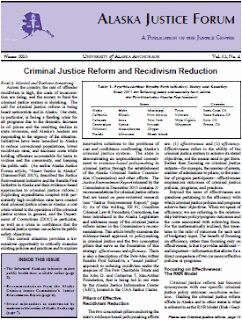
"Criminal Justice Reform and Recidivism Reduction" by Brad A. Myrstol and Barbara Armstrong

This article briefly examines the evidence-based approach to policymaking in criminal justice. The article also describes the Pew-MacArthur Results First Initiative, a “smart justice” approach to reducing recidivism that is being led in Alaska by the Alaska Justice Information Center (AJiC), housed in the UAA Justice Center.

"Justice Reinvestment Report"

This article summarizes the Alaska Criminal Justice Commission's recommendations for criminal justice reform in Alaska included in the Commission's Justice Reinvestment Report released in December 2015.

"Sexual Misconduct: How Do UAA Students Define It?" by Lindsey Blumenstein

This article describes a qualitative study undertaken to explore how UAA students identify sexual violence and sexual misconduct, as well as the concept of consent.

"Informed Alaskans Initiative: Public Health Data in Alaska" by Barbara Armstrong

This article describes the Informed Alaskans Initiative launched by the Alaska Division of Public Health to make state and national public health data available online.

Thursday, February 18, 2016

Justice Center volunteers at point-in-time count and Project Homeless Connect Anchorage 2016

Dr. Sharon Chamard, Justice faculty, and Barbara Armstrong, editor, Alaska Justice Forum, joined scores of other volunteers to assist with the annual HUD point-in-time count of homeless persons and Project Homeless Connect on January 27, 2016 in Anchorage.

Dr. Chamard assisted with the annual point-in-time count of persons at homeless encampments. Barbara Armstrong worked with volunteers doing data entry for the individuals served at Project Homeless Connect at the Egan Convention Center.

 The PIT (point-in-time) annual counts for HUD provide counts of sheltered and unsheltered people experiencing homelessness on a single night. This data is used in policymaking and determining assistance for homeless persons on the local, state, and federal levels.

Project Homeless Connect brings together service providers and government agencies under one roof to provide homeless persons with the services they need. Services provided included haircuts, health exams, legal services, housing and employment information, and referrals to mental health and substance abuse counseling. The Anchorage Coalition to End Homelessness (ACEH) is the organizer of the event. A total of 797 clients were served at the Anchorage Project Homeless Connect event this year.

Data entry volunteers for
Project Homeless Connect.


Project Homeless Connect events were also held in Juneau, Fairbanks, and Kenai. Final statewide data on numbers served and the point-in-time count of homeless persons are being compiled and will be released at a later date.

Friday, November 6, 2015

Summer-Fall 2015 issue of the Alaska Justice Forum

Alaska Justice Forum 32(2–3), Summer/Fall 2015
The Summer/Fall 2015 issue of the Alaska Justice Forum presents articles on a survey of studies on judicial selection methods used by U.S. states, selected milestones from the UAA Justice Center's 40-year history, an intervention to reduce public disorder in Anchorage's Town Square Park, 2014 institutional populations under authority of the Alaska Department of Corrections, and smart justice initiatives in Alaska.The 12-page issue includes the following articles:

"A Survey of Studies on Judicial Selection" by Ryan Fortson and Kristin S. Knudsen

The Alaska legislature is considering a bill — Senate Joint Resolution 3 — that would put before voters a state constitutional amendment to change the composition of the Alaska Judicial Council and the way its members are selected. The Alaska Judicial Council plays a constitutionally-mandated role in the selection of Alaska’s judges and also makes recommendations to voters concerning retaining or not retaining judges as part of the judicial retention election process. This article reviews selected existing studies relevant to potential effects of this proposed change to the council composition — studies that examined judicial effectiveness, responsiveness of judges to public opinion, and public perception of judges.

"UAA Justice Center 40th Anniversary 1975–2015"

In celebration of its 40th anniversary, the UAA Justice Center presents a timeline of selected milestones from its history.

"'Activating' Park Spaces in Anchorage’s Town Square Park (Research Note)"
by Troy C. Payne and Daniel Reinhard

This brief research note describes an intervention designed to increase activity in Anchorage's Town Square Park in an effort to reduce public disorder in the park. An abbreviated evaluation of the intervention is included.

"2014 Alaska Department of Corrections Institutional Population"

This article looks at highlights from the 2014 Alaska Offender Profile published by the Alaska Department of Corrections (DOC), with a focus on the 2014 institutional population defined as pretrial detainees, post-conviction inmates, and probation and/or parole violators housed in a correctional facility. A brief sidebar describes Alaska's unified system of corrections.

"Smart Justice in Alaska" by Barbara Armstrong

Smart justice initiatives seek to reform criminal justice systems by reducing correctional populations and recidivism while lowering costs, maintaining offender accountability, and ensuring public safety. This article describes two smart justice initiatives underway in Alaska, “Results First” and “Justice Reinvestment."

"Faculty Notes"

Dr. Brad Myrstol and Prof. Kristin Knudsen have been recognized with Chancellor's Awards for Excellence. Prof. Deb Periman has been promoted to Professor of Justice. Prof. Jason Brandeis has been awarded tenure and been promoted to Associate Professor.

"Alaska Justice Information Center Welcomes Staff"

Araceli Valle, Ph.D., and Karin Thomas, M.S., have joined the staff of the Alaska Justice Information Center (AJIC) as Research Professionals.

Friday, August 28, 2015

DHSS Commissioner keynotes at College of Health 2015 All-College meeting

2015 COH All-College Meeting at Lucy Cuddy Hall.


L to r: COH Dean Bill Hogan and
DHSS Commissioner Valerie Davidson.
Alaska Department of Health and Social Services Commissioner Valerie Davidson gave the keynote presentation  at the COH All-College meeting on August 19. She discussed Medicaid expansion and redesign of the Alaska system, and the important role the College of Health plays in supporting the delivery of health services in the state.

Commissioner Davidson noted, "We count on the work of the College of Health. You are making a difference - improving the health and lives of Alaskans."

 Dean Bill Hogan presented information on the COH programs and budget, outlined some of the major accreditation efforts over the past and coming academic year, welcomed new COH units, and recognized new faculty and staff.


Dr. Bart Quimby, UAA Academic
Planning.
Dr. Bart Quimby from UAA Academic Planning, spoke briefly about the steps the Anchorage campus is taking to look at alignment of unit missions, state priorities, and student needs in this time of budget constraints. The meeting closed with a round-robin presentation by the COH Leadership Team highlighting the challenges and opportunities facing us this academic year. Dr. André Rosay was unable to attend the meeting; Barbara Armstrong, editor of the Alaska Justice Forum, and Charlotte Titus, Office Manager, presented Justice Center program and budget information.


Barbara Armstrong, Justice Center.
Charlotte Titus, Justice Center.
Barbara highlighted the Alaska Justice Information Center (AJIC) and the director, Dr. Brad Myrstol. She described AJIC's first project with the Pew-MacArthur Results First Initiative which focuses on examining specific cost-benefit ratios of justice system programs and helping policy makers make better decisions about investing general fund money in programs with evidence-based impact. AJIC will be expanding its work to other areas that impact offending and recidivism, including physical and behavioral health care.
 

Thursday, June 18, 2015

Spring 2015 issue of the Alaska Justice Forum

Alaska Justice Forum 32(1), Spring 2015The Spring 2015 issue of the Alaska Justice Forum presents articles on the relationship between adverse childhood experiences (ACEs) and alcohol abuse in adulthood, limiting public access to criminal records, police–public contacts in Anchorage, and officer-involved shootings in Anchorage. The 20-page issue includes the following articles:

"Adverse Childhood Experiences and Their Association with Alcohol Abuse by Alaska Adults" by Marny Rivera and Patrick Sidmore

This article examines the prevalence of adverse childhood experiences (ACEs) — such as abuse and household dysfunction in childhood — and its association with adoption by Alaska adults of the health-risk behaviors of heavy and binge drinking. The behavioral health of Alaskans could be improved by addressing the association between ACEs and health-risk drinking behaviors, and establishing an integrated prevention system. A statistical web supplement provides supporting statistical information.

"Expungement and Limiting Public Access to Alaska Criminal Case Records in the Digital Age" by Barbara Armstrong and Deborah Periman

A criminal record results in a number of different barriers to reentry into the community for former offenders. These barriers — also called collateral consequences — can be mitigated by reducing the extent to which criminal records are visible to employers, landlords, and others. This article provides a brief overview of the complexity involved in limiting public access to criminal records, processes adopted in other states, and recent legislative proposals and current options in Alaska.

"Contacts between Anchorage Adults and Police" by Brad A. Myrstol

This article presents selected results from a pilot study of police–citizen contacts conducted in Anchorage, Alaska in May 2013. The pilot study was part of a larger effort to establish a statewide police–public contact survey that will allow for comparison between Alaska-specific and national police–public contact estimates.

"Officer-Involved Shootings in Anchorage 1993–2013" by Troy C. Payne

This article presents findings from the December 2013 report Officer-Involved Shootings in Anchorage 1993–2013, which describes shootings involving officers of the Anchorage Police Department (APD) for the period January 1, 1993 through May 11, 2013.

"Forum to Publish 3 Times Per Year"

The Alaska Justice Forum is changing from a quarterly publication schedule to publishing three times per year.

Wednesday, April 29, 2015

UAA participates in 5th annual UAF Cyberconference on Dispute Resolution

UAA was one of nearly 20 videoconference sites for the UAF 5th Annual International Cyberconference on Dispute Resolution held on April 15. This year's keynote speaker was Raf Gangat. Mr. Gangat is a former South African Ambassador to the Palestinian Territories, to the United Emirates, and a former Consulate General to Pakistan. He currently works as a communication and media consultant in East Jerusalem, Israel.

Papers submitted for the conference are being considered for inclusion in the next issue of the UAF Alaska Journal of Dispute Resolution.
Dr. Cory R. Lepage, Justice Center faculty, and Barbara Armstrong, editor of the Alaska Justice Forum, are on the editorial board.

Prof. Brian Jarrett, UAF Dept. of Communications, was the lead facilitator for the conference.  He is a sociologist and a mediator. Contact him at bnjarrett@alaska.edu

Participating videoconference sites:
Alternative to Violence Project, Seattle, Washington
Asad University, Tehran, Iran
Law Office of Adam Gulkis, Anchorage, Alaska
Ministry of Children and Family Development, British Columbia
Ministry of Justice, British Columbia, Canada
Native American Rights Fund, Boulder, Colorodo
Northern Institute for Social Justice, Yukon College, Whitehorse, Yukon
Northern Justice and Criminology, Yukon College, Whitehorse, Yukon
Office of Alaska Lt. Governor Byron Mallot, Juneau, Alaska
Office of Raf Gangat, East Jerusalem, Israel
Organized Village of Kake Circle Peacemaking, Kake, Alaska
Salisbury University, Department of Conflict Analysis, Salisbury, Maryland
Simon Fraser University, School of Criminology, British Columbia
State of Hawaii Telehealth Access Network
University of Alaska Anchorage
University of Alaska Fairbanks
University of Guam, Mangilao, Guam
University of Hawaii, Manoa, Matsunaga Institute for Peace and Conflict Resolution
University of Puerto Rico School of Law
University of Texas, Austin
VisionAlaska, Inc. - Alaska Brethren Ministries, Sterling, Alaska

Topics included:
Therapeutic Jurisprudence and Inter-Cultural Conflict
The Causes and Consequences of Inter-Cultural Conflict and the Value of Restorative Practices
Circle Peace-Making, Indigenous Knowledge, and Dispute Resolution

A detailed agenda and full list of participants is on the conference website.

Tuesday, March 24, 2015

5th annual UAF international cyberconference on dispute resolution set for April 15

UAF will host their 5th annual International Cyberconference on Dispute Resolution in April 2015. UAA is an annual participating member.

A call for papers for the Alaska Journal of Dispute Resolution is issued in conjunction with the invitation to the cyberconference. Dr. Cory R. Lepage, Justice faculty, and Barbara Armstrong, editor, Alaska Justice Forum, a research publication of the Justice Center, serve on the editorial board of the journal.

Videoconference date: Wednesday,  April 15, 2015
Time: 11:00 a.m. - 1:30 p.m. (ADT)
Videoconference connection: Contract Jerry Farnam at UAF 2 weeks in advance to confirm a video connection.   Email ua-video@alaska.edu
UAA videoconference site: UAA Administration Bldg., Room 201
Parking at UAA: Look for kiosks in parking lots to pay for visitor parking.
Map

Approved for continuing legal education (CLE) credit by the Alaska Bar Association: 2.5 general credits

See conference website for agenda details.

The theme is Inter-Cultural Conflict Resolution. The sessions include:
  • Therapeutic Jurisprudence and Inter-Cultural Conflict Resolution
  • The Causes and Consequences of Inter-Cultural Conflict and the Value of Restorative Practices
  • Circle Peace-Making, Indigenous Knowledge, and Dispute Resolution

Contact Prof. Brian Jarrett, Director, UAF Program on Dispute Resolution, Peace-building, & Restorative Practices for further information and to submit papers in APA format at  bnjarrett@alaska.edu

Tuesday, February 3, 2015

UAA community volunteers at Project Homeless Connect 2015

UAA student volunteers from Dr. Sharon Chamard's JUST 490 class - front row left to right:
Dr. Chamard, Lakedria Hall, Adler Yambao. Back row l to r: Daniel Reinhard, Russell Baluyut,
Ryan Jakubek, Jordan Oberlander. Not pictured Coy Hill.
Members of the UAA community volunteered at the 13th Annual Anchorage Project Homeless Connect (PHC) held at the Egan Center on Wednesday, January 28, 2015.  The Anchorage Coalition to End Homelessness presents this day-long program with the help of community sponsors and volunteers. The goal is to move our community closer to ending homelessness.

Among UAA community volunteers for the 2015 PHC were Dr. Sharon Chamard, Justice Center faculty and students from her JUST 490 Homelessness & Crime class - Russell Baluyut, Lakedria Hall, Coy Hill, Ryan Jakubek, Jordan Oberlander, Daniel Reinhard, and Adler Yambao; Barbara Armstrong, editor, Alaska Justice Forum, Justice Center; and Heather MacAlpine, Justice alum and Municipality of Anchorage Associate Ombudsman.

This event brings together service providers and government agencies under one roof to assist homeless persons in identifying their top 3 issues of concern, and then links individuals with the appropriate provider. Services provided included haircuts, health exams, legal services, housing and employment information, and referrals to mental health and substance abuse counseling.

Hospitality is an important part of the day and a lunch is served to attendees.  As they leave the event, participants are offered canned food items, fresh produce, and clothing to take with them.  Similar programs are presented in cities across the United States.

At the Municipality of Anchorage Emergency Operation Center, volunteers
entered information about PHC clients including demographics, duration of
homelessness, and other details to assist service providers and public agencies.
(Photo by Judith Atkins, Municipality of Anchorage)
The initial interview with each attendee also presents an opportunity for collecting information about who is homeless and why.  These data are aggregated and provide a tool to assist service providers and government agencies in policy making and structuring services.

Preliminary estimates show several hundred individuals and families were served on January 28, and over 200 volunteers assisted. The data for the final report for this event will be tabulated over the next several weeks.

Friday, September 26, 2014

Spring/Summer 2014 issue of the Alaska Justice Forum

Alaska Justice Forum 31(1–2), Spring/Summer 2014The Spring/Summer 2014 issue of the Alaska Justice Forum includes articles on marijuana laws and policies, homelessness statistics for Alaska and the U.S., the newly-created Alaska Criminal Justice Commission, and the Alaska Court System's Early Resolution Program (ERP) for family law cases. The 20-page issue includes the following articles:

"Shifting Marijuana Laws and Policies: Implications for Alaska" by Jason Brandeis

Marijuana regulation continues to be a pressing criminal justice and social policy issue both in Alaska and across the nation. A ballot measure that would legalize, tax, and regulate marijuana in Alaska will be before the state’s voters at the November 2014 general election. This article summarizes Alaska’s current marijuana laws, identifies recent changes to other state laws and federal policies related to marijuana use and possession, and discusses the impact of those changes on Alaska’s marijuana laws.

"The Homeless: Who and How Many?" by Barbara Armstrong and Sharon Chamard

Across the nation in both rural and urban areas, public and private agencies work to provide services for homeless people. One of the biggest challenges is collecting data about homeless individuals: how many people are homeless, who they are, what services they need most, and how long they have been homeless. This article looks at reports from 2012, 2013, and 2014 on estimates of homelessness in the U.S. and Alaska, the subpopulations of homeless individuals, and the various definitions of homelessness. References for sources cited are provided. Web supplements provide more detailed tables and an expanded bibliography of resources on homelesseness.

"The Alaska Criminal Justice Commission: A Legislative Call for Action" by Mary Geddes

With its enactment of Senate Bill 64 during the 2013–2014 legislative session, the Alaska Legislature created the Alaska Criminal Justice Commission. This article describes the work of the commission, which is charged with evaluating and making recommendations “for improving criminal sentencing practices and criminal justice practices, including rehabilitation and restitution” over a three-year period. An accompanying sidebar describes other provisions of SB 64, the omnibus crime bill.

"Early Resolution for Family Law Cases in Alaska’s Courts" by Stacey Marz

The Early Resolution Program (ERP), the first program of its kind in the nation, was developed by the Alaska Court System's Family Law Self-Help Center to provide self-represented litigants in family law cases with free legal assitance and mediation to help resolve issues and reach settlements without protracted court trials. This article discusses the ERP's goals and development, describes how cases are screened and processed, and presents ERP statistics though August 2014. An accompanying sidebar provides a program timeline, and a web supplement outlines how attorneys and judges approach various issues in a case at an Early Resolution Program (ERP) hearing.

"New Faculty"

Professor Lindsey Blumenstein has joined the Justice Center faculty as of the Fall 2014 semester.

Tuesday, June 3, 2014

Justice Center first UAA unit to have research published on ScholarWorks@UA

ScholarWorks@UA, the statewide online institutional repository for digital copies of research and scholarship by University of Alaska (UA) faculty, staff, and students, launched in September 2013. This website provides free, public access to digital documents.

The Justice Center is the first unit at UAA to have its research published on ScholarWorks@UA.

The UA campuses in Fairbanks, Anchorage, and Southeast are the primary participants in this first phase, and research from other campuses will be added in the future.

 UAA content is being added by Erik Carlson, Metadata Librarian, UAA/APU Consortium Library. Justice Center publications now on the site include:
  • Alaska Justice Forum, vol. 8 (1991) through vol. 30, no. 3 (Winter 2014) 
  • Alaska Justice Statistical Analysis Center (AJSAC) Fact Sheets, 2012-01 through 2013-05 

Click here for ScholarWorks@ UA https://scholarworks.alaska.edu/

The Justice Center is a member of  the UA Institutional Repository Review Advisory Board which reviewed the development of the site.  Stephen Rollins, Dean of the UAA/APU Consortium Library; Rebecca Moorman,  Head of Technical Services, Consortium Library; and Barbara Armstrong, Alaska Justice Forum editor, UAA Justice Center, represent UAA on the board.

Thursday, February 6, 2014

UAA community volunteers at 2014 Project Homeless Connect

Members of the UAA community volunteered at the 12th Annual Anchorage Project Homeless Connect (PHC) held at the Egan Center on Wednesday, January 29, 2014.  The Anchorage Coalition to End Homelessness presents this day-long program with the help of community sponsors and volunteers. The goal is to move our community closer to ending homelessness.

UAA community volunteers for the 2014 PHC included Heather MacAlpine, Justice alum and Municipality of Anchorage Associate Ombudsman; Jack Runser, UAA Human Services major; and Barbara Armstrong, editor, Alaska Justice Forum, Justice Center.  

This event brings together service providers and government agencies under one roof to assist homeless persons in identifying their top 3 issues of concern, and then links individuals with the appropriate provider.  Hospitality is an important part of the day and a lunch is offered to attendees, as well as canned food items to take with them.  Similar programs are presented in cities across the United States.

The initial interview with each attendee also presents an opportunity for collecting information about who is homeless and why.  This data is aggregated and provides a tool to assist service providers and government agencies in policy making and structuring services.

Preliminary estimates show that 600 individuals were served on January 29. The final report for this event will be available shortly.

Tuesday, October 15, 2013

30th annual tribal courts conference in Fairbanks brings together federal, state, and local representatives

Dr. Cory Lepage and Dr. Ryan Fortson, Justice faculty, and Barbara Armstrong, editor of the Alaska Justice Forum, attended the 30th Annual Alaska Tribal Court Development Conference, August 6-8, in Fairbanks. The event was hosted by the Tanana Chiefs Conference.

Forty-seven tribal courts were represented at the conference. Participants included tribal court judges, court clerks, tribal administrators, Native village representatives, as well federal and state agency representatives.  The agenda included presentations on tribal court initiatives, tribal court assessments, funding opportunities for tribes, due process in tribal courts, child protection cases in tribal courts, diversion programs for youth, state-tribal relations, and state court outreach.

At the conference, Chief Judge Ingrid Cumberlidge of the Qagan Tayagungin Tribe, Sand Point, was presented a Faculty Award Milestone from the National Tribal Judicial Center at the National Judicial College for 5 years of teaching. Judge Cumberlidge has volunteered many hours of her time to teach for the National Judicial College.

 The conference is funded by the U.S. Department of Justice and the Bureau of Indian Affairs through the National Tribal Judicial Center at the National Judicial College, Tanana Chiefs Conference, and the University of Alaska Fairbanks Tribal Management Program.

Opening day of the conference.

Chief Justice Robert Yazzie (Ret.),
Supreme Court of the Navajo Nation,
Window Rock, Arizona.

  
L to r (standing): Prof. Kevin Illingworth, UAF Tribal Management
Program; John Moller, Office of Governor Sean Parnell; Dr. Ryan Fortson &
Dr. Cory Lepage, UAA Justice Center; Prof. Jeff May, UAF Justice Dept.
Seated in foreground: Lisa Jaeger, Tanana Chiefs Conference

Chief Judge David Raasch (Ret.),
Mohican Nation Tribal Court

Justice Dan Winfree,
Alaska Supreme Court

L to r: Dr. Cory Lepage, UAA Justice Center; Judge David Voluck,
Central Council of Tlingit and Haida Indian Tribes of Alaska;
Dr. Ryan Fortson, UAA Justice Center; attorneys Holly Handler
and Tina Reigh, Alaska Legal Services Corporation.

L to r: Christine Folsom-Smith, Director, National Tribal Judicial
Center, National Judicial College, presents a
Faculty Milestone Award to Chief Judge Ingrid Cumberlidge
of Sand Point.

Tuesday, September 10, 2013

UA statewide online institutional repository for faculty, staff and student research goes live - ScholarWorks@UA

ScholarWorks@UA, the statewide online institutional repository for digital copies of research and scholarship by faculty, staff, and students, is now live. This website provides free, public access to digital documents. UAF, UAA, and UAS are the primary participants in this first phase, and research from other campuses will be added in the future.

Currently, only UAF has content on the site; UAA will be adding content next month. Click here for ScholarWorks@ UA https://scholarworks.alaska.edu/

The Justice Center is a member of  the UA Institutional Repository Review Advisory Board which reviewed the development of the site.  Stephen Rollins, Dean of the UAA/APU Consortium Library; Rebecca Moorman,  Head of Technical Services, Consortium Library; and Barbara Armstrong, Alaska Justice Forum editor, UAA Justice Center, represent UAA on the board. Dean Rollins is leading the effort at UAA to place UAA content on the website, and will be working with Rebecca Moorman; Professor Kate Gordon, Institutional Repository Librarian at UAA; and Barbara Armstrong.

Friday, August 23, 2013

Four individuals from Justice Center nominated for 2013 Chancellor's Awards for Excellence


Two faculty members and two staff members from the Justice Center have been nominated for 2013 Chancellor's Awards for Excellence:

  • Dr. Brad Myrstol - Associate Professor - For Excellence in  Research/Creative Activity
  • Prof. Deb Periman, J.D. - Associate Professor - For Excellence in Service to the Community
  • Barbara Armstrong - Research Associate - For Staff Excellence
  • Tuyet Tran - Academic Program Specialist - For Staff Excellence in Service to Students

The Chancellor's Awards promote excellence in what we do and recognize individuals and groups for their exceptional service to the university community.

There are group and individual awards in nine categories.  Winners will be announced at the September 20 Faculty and Staff Convocation at the Wendy Williamson Auditorium.

Tuesday, August 13, 2013

Justice Center participates in National Science Foundation workshop at UAF on becoming a messenger for science - winning support for research

L to r: Dr. Sharon Chamard, Dr. Troy Payne, and Barbara Armstrong
at the UAF Wood Center, site of the workshop.
Dr. Sharon Chamard and Dr. Troy Payne, Justice faculty, and Barbara Armstrong, Alaska Justice Forum editor,  attended the National Science Foundation  (NSF) workshop, "Science: Becoming the Messenger," held at the University of Alaska Fairbanks (UAF) on July 17.

The “Science: Becoming the Messenger” workshop, which is offered by NSF all over the nation, equips attendees with the skills and techniques communications professionals use to influence people’s thinking and attitudes, and demonstrates how these skills can be used to win support for research. The workshop was led by three experienced science communicators, and covered strategies from crafting a message to delivering it  - using both traditional and new media.

Dr. Chamard on screen in the video shown at the workshop.
Part of this interactive program included filming a video of a "pitch" for funding for a project using some of the techniques that had been demonstrated earlier. Participants videoed each other using cell phones or other mobile devices.

Dr. Chamard's video was chosen by the workshop leader, Joe Schreiber, to use as an example of how to edit and use still photos  with a video. Mr. Schreiber took the raw video, edited it, inserted appropriate stills related to the topic, then showed it to the group.

In the video, Dr. Chamard explains that her project would look at spatial predictors for where homeless encampments are located, and the environmental impact of those encampments, including the risk of accidental/intentional fires, habitat destruction, and health and sanitation issues. Using spatial predictors, public agencies and social service providers could more easily find homeless encampments. This would allow them to offer alternative housing arrangements to campers, and close the camps before they become so large and entrenched that they are environmental hazards.


Among other UAA community members who attended the program were Dr. Diane Hirshberg, Director, Center for Alaska Education Policy Research; Prof. Mara Kimmel, Dept. of Political Science & ISER;  Dr. Bridget Hanson, Research Assistant Professor, Center for Behavioral Health Research and Services; and Dr. Jonathan Alevy, Economics Department.

Dr. Hirshberg was one of the attendees selected to present her proposed project to the entire workshop audience. The audience voted on whether projects should hypothetically be funded or not, and Dr. Hirshberg successfully convinced the group that her project  - which focused on education in Alaska - should be awarded foundation support.  Her next assignment was a mock interview with a real-life journalist during which she had to defend her project and the hypothetical funding award.  Dr. Hirshberg persuasively answered all the challenges and questions put to her during the interview.


On stage: Dr. Hirshberg (r) is interviewed by Chris Mooney,
a Washington, D.C. journalist.

Tuesday, July 16, 2013

Justice faculty and staff hear exoneree Ted Bradford at Alaska Innocence Project program

Dr. Allan Barnes, Justice Center Director; Prof. Deb Periman, J.D., Justice faculty; and Barbara Armstrong, Alaska Justice Forum editor attended the May 2013 Alaska Innocence Project program and fundraiser highlighting exoneree Ted Bradford.

L ro r: AKIP Executive Director
Bill Oberly and exoneree Ted Bradford
at the 2013 event.
Ted Bradford was wrongly convicted of the 1995 rape of a woman in Washington state; he served 9 years in prison. Through the efforts of the Innocence Project Northwest at the University of Washington School of Law, Mr. Bradford was exonerated in 2010. He shared the story of his experience at the Alaska Innocence Project program and fundraiser in May, and ended his remarks by playing his guitar for the group.

L to r: Dr. Allan Barnes and
Prof. Deb Periman of the Justice
Center at the AKIP event.
The Alaska Innocence Project (AKIP) is one of the Justice Center's community partners.  AKIP is overseen by a diverse, all volunteer Board of Directors made up of former police, former prosecutors, Alaska Native leaders, and other community members. Bill Oberly is the Executive Director and handles day-to-day operations. Volunteer attorneys, paralegals, and investigators assist with the work of the AKIP. Justice Center paralegal students have worked in internships with the Alaska Innocence Project.